
Dr. Rachel: Avoiding the Hedonic Treadmill

By Dr. Rachel Boehm,
“Aren’t you frustrated? You climb, and you climb, and you don’t get anywhere.”
Bette Midler’s humorous observation in The First Wives Club was about Goldie Hawn’s character’s obsessive StairMaster climbing habit. But, it might as well have been about our own less-than-satisfying quests for happiness.
People use the term "happiness" casually, thinking we all share the same meaning and understanding of the concept. So let me level-set first; otherwise, this piece may vex rather than assist.
Two Types of Happiness
Happiness is not contentment, joy, fulfillment, or flourishing.
In my dissertation, I studied the difference between two types of well-being, "hedonic" and "eudaemonic." Hedonic is essentially happiness or satisfaction (even job satisfaction) experienced within in a fleeting moment of time. Eudaemonic, however, is essentially flourishing over time. It suggests comprehensive well-being and contentment.
Now, there are some very popular writers and lecturers who use “happiness” to mean longterm fulfillment. They are doing that, I think, because the word "happiness" likely seems easier to grasp than “fulfillment” or the Greek term “eudaemonia.” But I have faith you can grasp the difference between these terms.
The Hedonic Treadmill
I’ll come back to "eudaemonic" in a minute. But let's first understand "hedonic." Deriving from the Ancient Greek word hēdonē (ἡδονή), meaning "pleasure" – after the goddess of pleasure, Hedone, daughter of Eros and Psyche – the word suggests the sort of happiness derived from maximizing joyful experiences in the moment and avoiding feelings of pain.
In contemporary psychology, however, this way of being can lead to what's termed the Hedonic Treadmill. If you haven't heard the term, it’s essentially what Bette Midler perceives Goldie Hawn doing in the film – climbing and climbing, but never getting anywhere. When we chase happiness by seeking momentary gratification as a means of warding off painful experiences, we put ourselves on this sort of treadmill.
Recent research has demonstrated, however, that human nature tends to return us to a baseline of emotional stability. We experience or achieve something pleasurable – from thrilling over an epic ice cream sundae on a hot summer day to earning a year-end bonus at work. But eventually the burst of happiness we feel slips away and we return to our baseline. Essentially, our brains adapt to the experience.
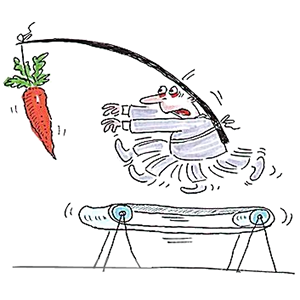
But, once you're on this Hedonic Treadmill, it's difficult to get off. As we achieve and experience greater moments of pleasure, our expectations of future gratification rise as well. Those expectations may be directed toward the outside world, i.e., what we expect from the universe or from others. Or, toward ourselves, where we feel we "need to keep up" with others at this new level of pleasure seeking. But, this adaptation also brings us back toward that baseline, or recurs back to the norm. So, in the end, our long-term “happiness” is unchanged because hedonic happiness is not long-term. It is, again, fleeting by nature.
The problem is, happiness feels awesome at the time. That fleeting high is a high we want. And if we're not careful, we chase it and chase it. Thus, the treadmill (or StairMaster climbing) that leaves us in the end feeling we never actually got anywhere.
Fulfillment and Flourishing
So, what do we do? Should we abandon the pursuit of happiness? Not at all. Just know and accept that it is not meant to last forever. Enjoy it in the moment and chase something else… eudaemonic well-being (you can use "fulfillment" or "flourishing" if you prefer).
Interestingly, research shows us that when you improve your flourishing, your hedonic well-being does in fact improve as well. As does your physical, mental, and emotional health. As does your job performance and satisfaction. This holds across genders, ages, cultures, and for both entrepreneurs and employees.
Six Core Areas of Fulfillment
One of the best models I have found for comprehending this comes from Dr. Carol Ryff. We can use her template to help shape our journey toward flourishing. Ryff found there are six core areas we want to focus on. People may need different degrees of each, so this is for you to personalize. Check in with yourself and make sure you have what you need in this moment of your life.

Six Core Dimensions
- Autonomy: You live according to your own values and judgments. You’re guided by your internal compass, as opposed to unhealthy social pressures.
- Environmental mastery: You are effective in the world; you can handle the demands of daily life and know how to use the resources available.
- Personal growth: You engage in ongoing self-development and are open to new experiences.
- Positive relations: You hold trusting, deep, and empathetic interpersonal connections.
- Purpose in life: You have goals, direction, and a sense of meaning.
- Self-acceptance: You can look at yourself honestly, your strengths and shortcomings, and still be on your own side.
Using this sort of framework to develop our emotional intelligence and sense of agency, I believe can be a major driver of our longterm flourishing. This can certainly be done with a coach. But you can start with simple tools like books, podcasts, friendships, reflection practices, and practicing self-compassion and gratitude.
One final question to ponder: As you think about the season of life you're in, which of these six dimensions could use a little more attention?

Dr. Rachel Boehm is a resident of West Falls Church. She’s lived in the area for over 15 years and runs a modern change management firm helping leaders and employers navigate business transitions and constant busyness with less tension for more successful outcomes. Dr. Rachel holds a PhD in psychology focused on individual and organizational behavior.

Member discussion