
Dr. Rachel: Building Confidence, Part II

By Dr. Rachel,
Last month, I wrote about ways you can build confidence (below).
 Christopher Jones
In brief, we looked at:
- Succeeding after overcoming setbacks, which requires the view that failures aren’t the end of the story;
- The importance of watching someone else succeed, especially if that person is similar to you (e.g., your classmate, colleague, or exercise buddy);
- Receiving encouragement from someone you trust or in an authority position (e.g., a boss, mentor, teacher, parent, or friend);
- Reinterpreting the physical sensations from “OMG, I feel nervous,” to “I feel excited!,” or “This is a great opportunity.”
These strategies are great for the person who is confident enough to keep trying despite setbacks, has someone to look to who has paved or is paving the way, is around people who encourage them, or has learned how to reframe their feelings or physical experiences.
But, what if you don’t have these things?
The Need for Control
Professor Ian Robertson, a neuroscientist, has written How Confidence Works, a most helpful book on confidence-building.
Pulling together ample research, Robertson boils confidence down to perceived control. Humans love control. We need control. It is fundamental to our well-being and survival. We evolved to need it and crave it and love it because it helped our ancestors survive in unpredictable environments. And it increased our abilities to predict dangers – or respond quickly to those that could not be predicted – and to shape outcomes.
The need for control is still here, trying to help us survive, feel safe, and reduce uncertainty by influencing our emotions, thoughts, and actions. When we feel in control, we feel a sense of peace (Leotti et al., 2011). Which makes sense when you think about it.
Which also means that when we do not feel in control – meaning we do not believe we can influence the situation we're in or the people around us or the outcomes that might befall us – we feel anxious, afraid, and depressed. We are not at peace.
Robertson gathers the research and theories around this and various related concepts into a Four-part framework:
- Can’t do / Can’t happen: You don’t believe you can do it, and you don’t think it would make a difference even if you could.
- Can’t do / Can happen: You don’t believe you can do it, but if you could, you do believe it would make a difference.
- Can do / Can’t happen: You believe you can do it, but you don’t think it will make a difference.
- Can do / Can happen: You believe you can do it, and you believe it will make a difference. This is full confidence.
How to Strengthen Full Confidence
The ability to choose gives us the perception of control and the sense of peace accompanying it. (Leotti et al., 2011). This helps build our confidence because the sense that we can do something and that it will make a difference, heightens our assurance to act. And, this helps create a positive feedback loop in developing self-assurance. The ability to choose gives a sense of control, which helps us make first one choice, and then the next, with a sense of both peacefulness and rising confidence with each new choice.
Connecting those dots then gives us a path to building confidence. Essentially, focus on what you can control. The more you believe your actions will influence outcomes, the more in control you feel and the more confident you feel.
This will not only move you to act, but it will help your mind and body prepare you to act. You'll have that steadiness we think of when we think of confidence, versus the panic of fear or anxiety, or the frozenness associated with sadness or depression.
The feeling of control helps you automatically reinterpret the sweaty palms and racing heart. Instead of fear, anxiety, or “stress,” you experience them as stability under pressure, propelling you forward.
How to Take Control
So, how do we feel more in control? Well, the research tells us that the power to choose gives us a sense of control. So, look for opportunities to choose. The Circles of Control exercise is a great starting point.
The exercise pulls from Stephen Covey’s Circle of Concern, Influence, and Control. It’s three circles, one inside the other. It helps you identify what you can and cannot control and to what degree, so you know where to put your time, money, attention, and energy.
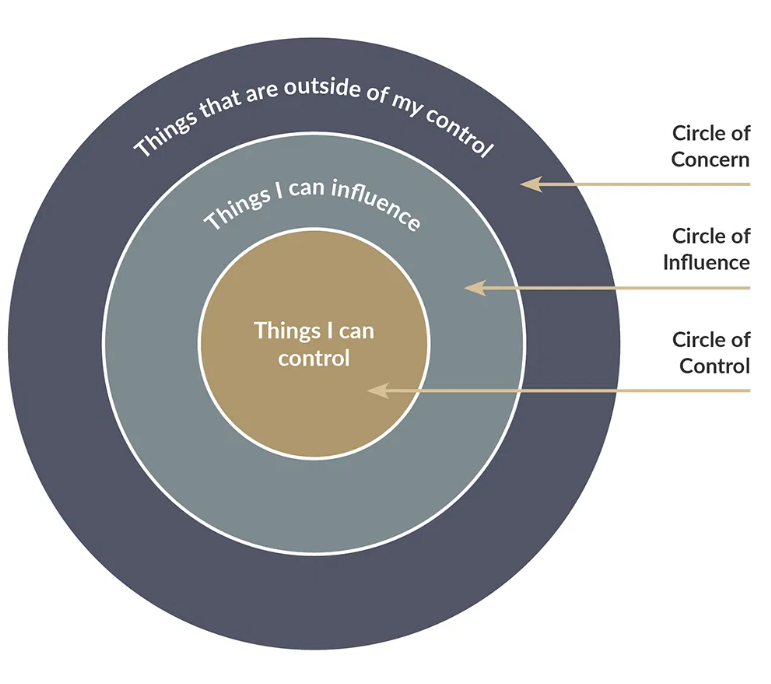
I tend to use the labels, No Control, Some Control, and Most Control, when working with clients. There is also this two-circle version. Use whichever version works best for you.
Once you've identified what you have control over, you've essentially created opportunities for yourself to choose. Exercising those choices creates feelings of control, which helps you feel more confident.
There are many other exercises therapists and coaches can use to help you improve the skill of focusing on what you can control, how you can strengthen your sense of having control over what happens to you in life, and how you can improve your confidence in areas where it feels lacking.

Dr. Rachel Boehm is a resident of West Falls Church. She’s lived in the area for over 15 years and runs a modern change management firm helping leaders and employers navigate business transitions and constant busyness with less tension for more successful outcomes. Dr. Rachel holds a PhD in psychology focused on individual and organizational behavior.


Member discussion