
F.C.’s ‘We The Neighbors Initiative’ Hosts Civil Discourse Panel, Workshops
As the civility of our public discourse has declined in recent years – with partisan rancor and fury arising across the political divide – many Americans are wondering how we might return to a time of healthier dialogue.
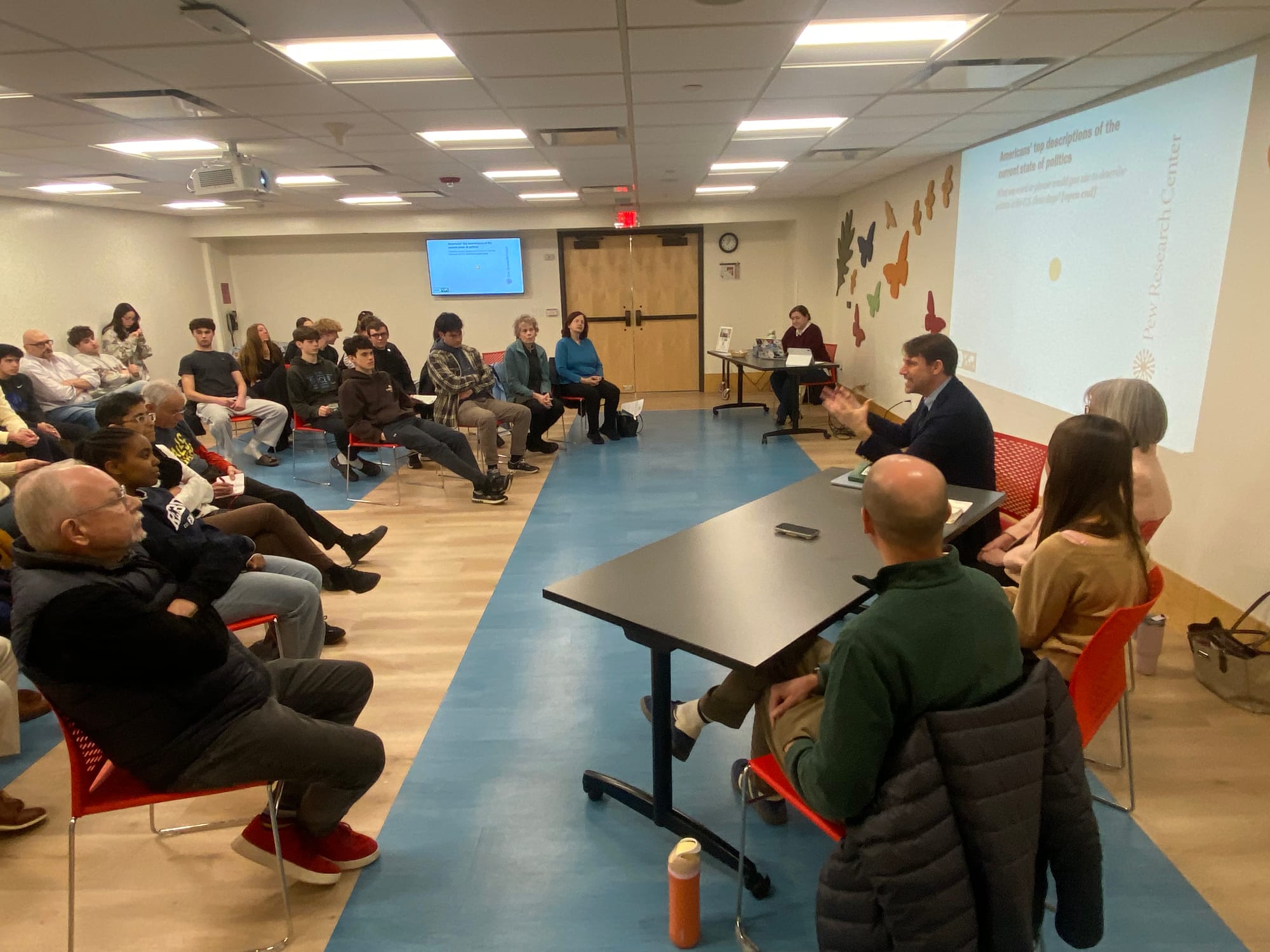
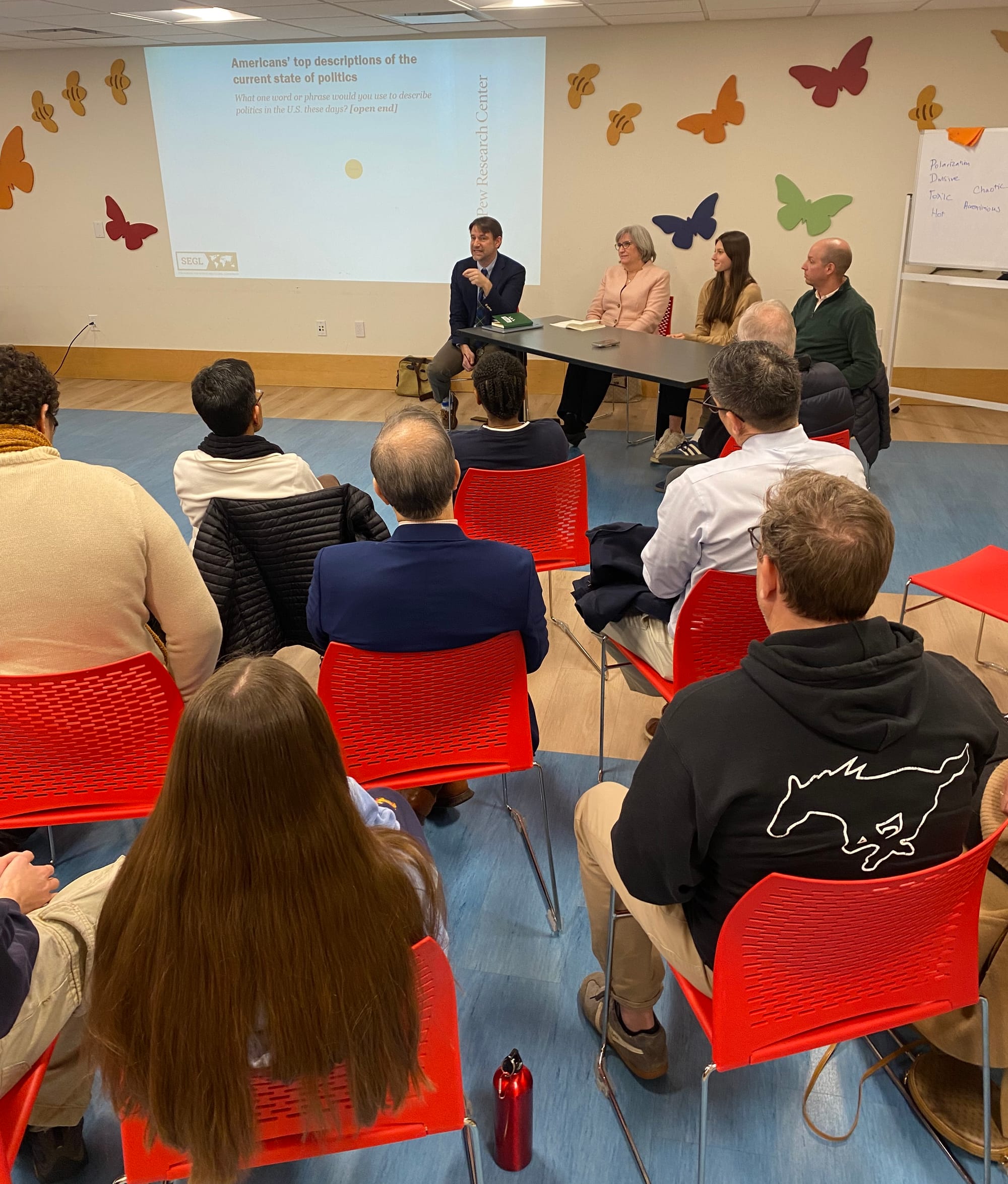
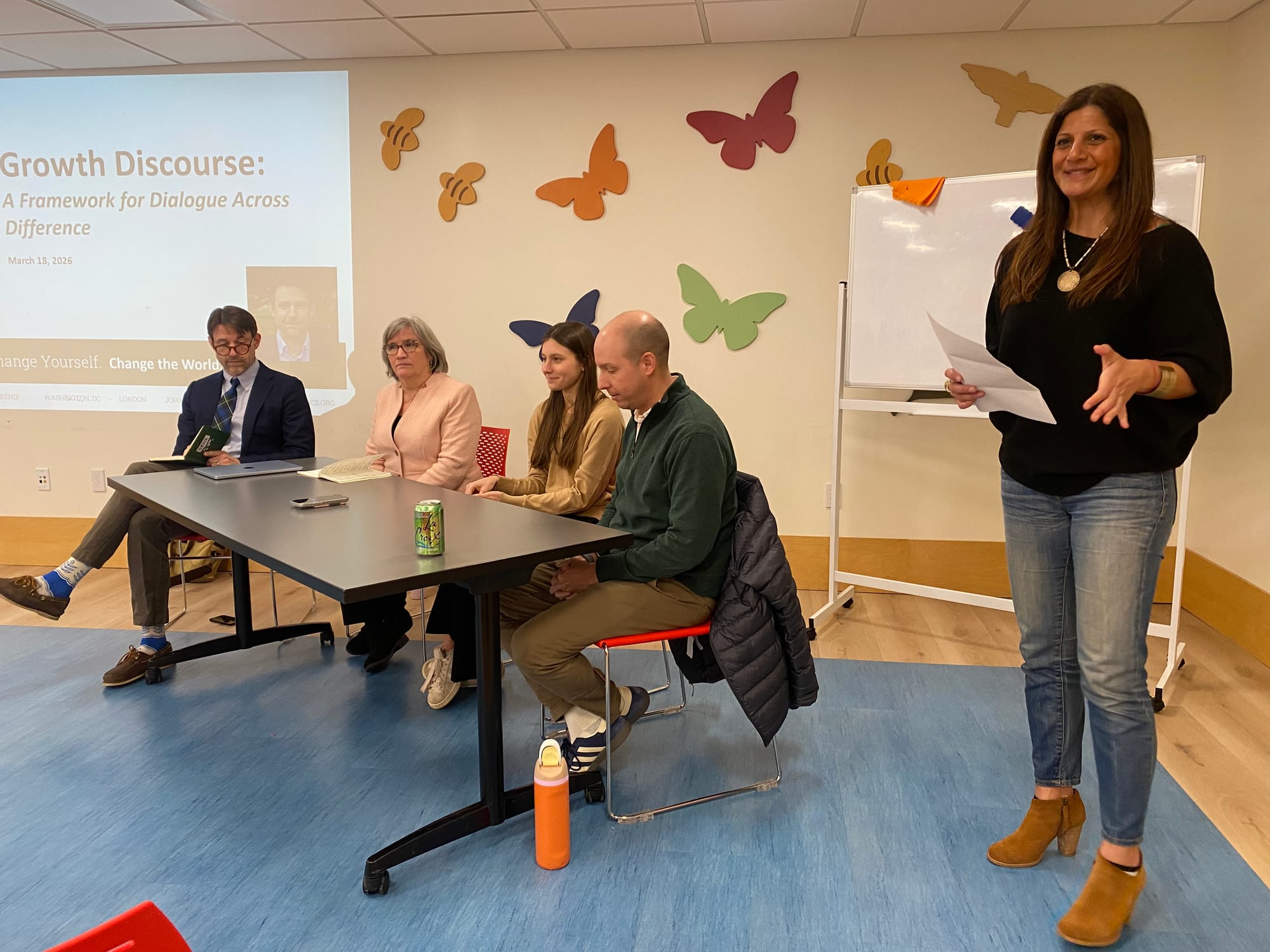
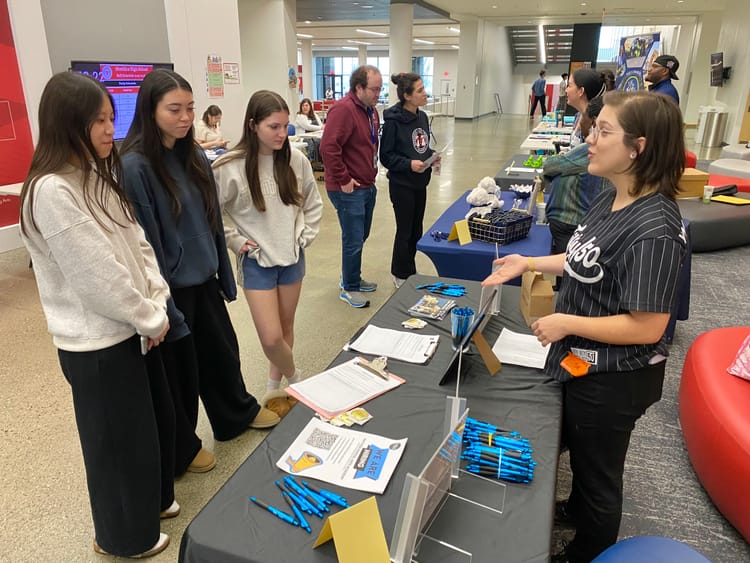
One newly-formed Falls Church City group – the “We the Neighbors Initiative” – held their inaugural public event, a March 18 panel discussion at Mary Riley Styles Public Library entitled “A Community Conversation,” with workshops designed to enhance skill-building in how to foster “Dialogue Across Difference.”
The event was well-attended by both Meridian H.S. students and adults, with approximately 30 audience members.
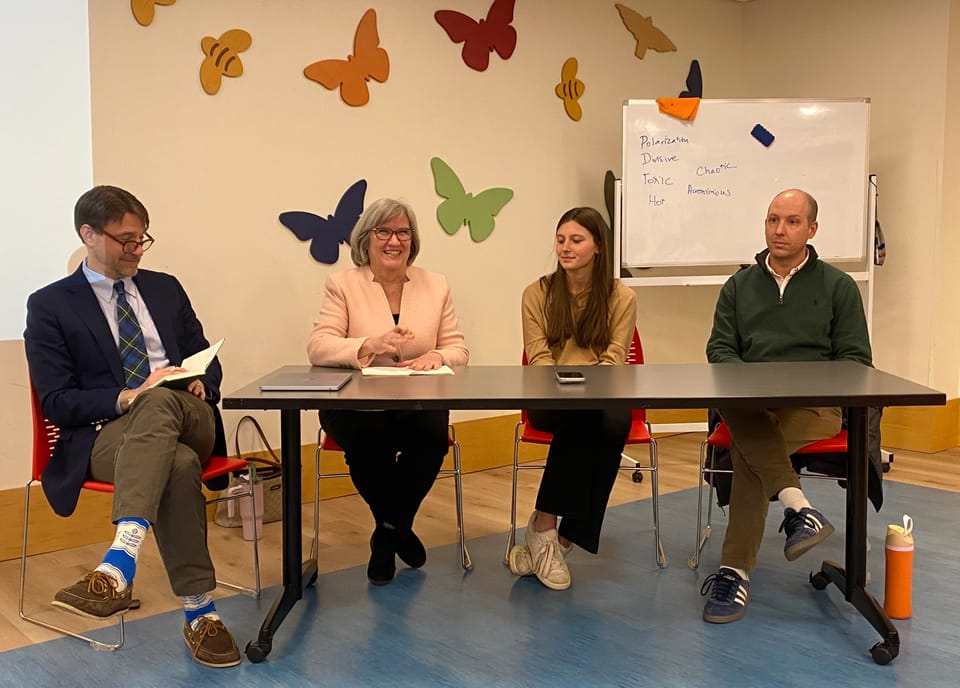
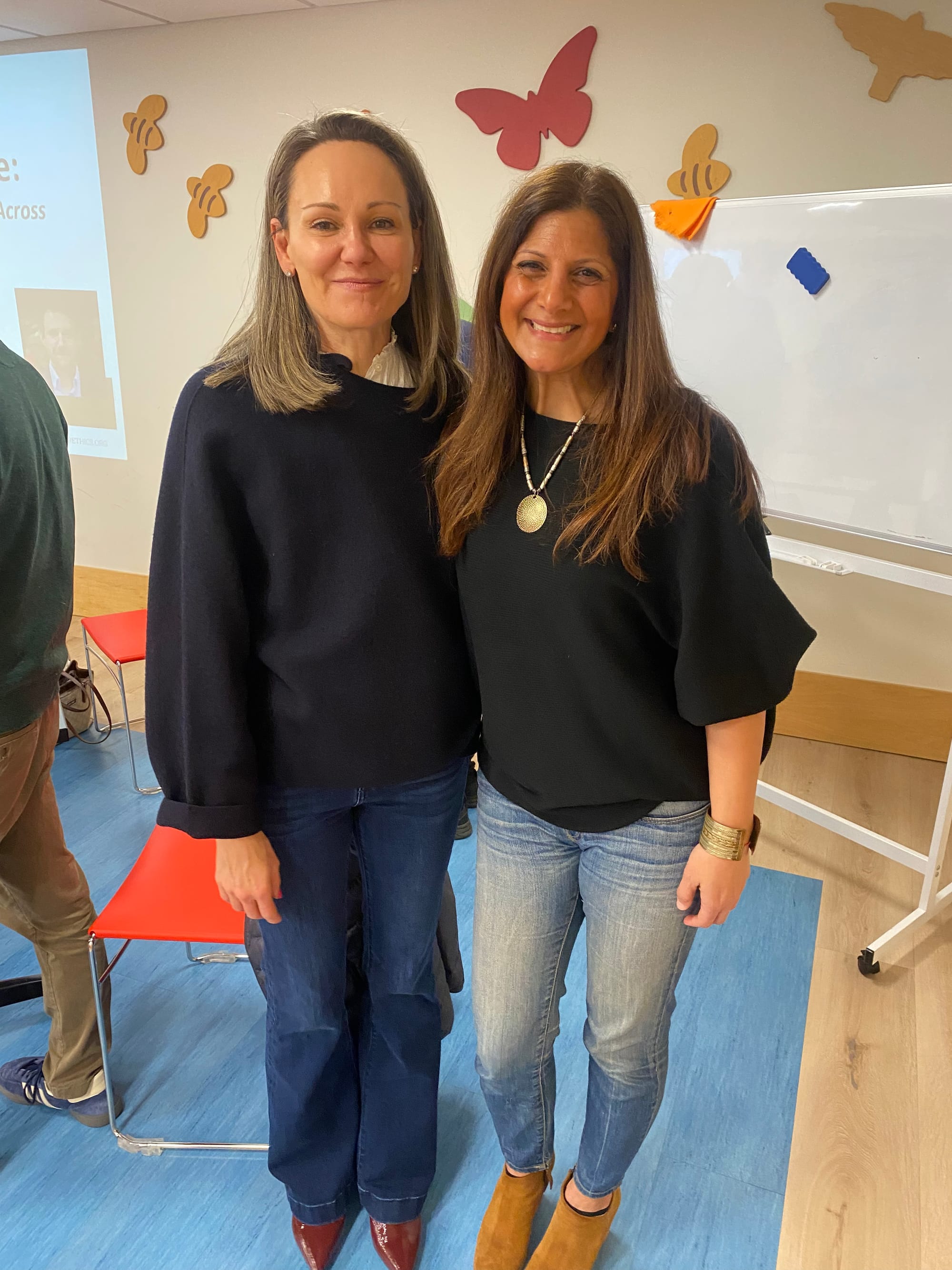
Organized by City of Falls Church parents Allison Stevens, Komal Bazaz Smith, and Olga Ioffe-Kasher – each with children who’ve attended Falls Church City public schools – the evening’s panelists included:
Noah Bopp: Head, School for Ethics and Global Leadership (SEGL)
Jared Peet: Individual & Societies Teacher, Meridian H.S.
MaryBeth Connelly: Member, Falls Church City Council
Cailyn Murphy: Senior, Meridian High School
“‘We the Neighbors’ is a Falls Church City Initiative dedicated to strengthening civic and community bonds – and our democracy – through meaningful, respectful dialogue,” the group announced in their inaugural public event invitation. “Join us for a panel discussion on communicating with empathy and finding common ground – even when we disagree.”
Entitled “Growth Discourse,” the skills-building curriculum presented for the evening was designed, and refined over years of in-school practice, by Head of SEGL panelist Noah Bopp, the emcee for the panel discussion and workshops coordinator.
Prior to the event, The Falls Church Independent spoke with co-organizer Komal Bazaz Smith about the “We the Neighbors Initiative” and the evening’s activities.
“Basically, we’ve been noticing a lot of increased polarization of discourse across the national level, and even here,” Bazaz Smith said. “We get a sense that it’s really hard to have hard conversations. And one of the things we’ve really been trying to understand is that it’s the basis of democracy to have hard conversations, and to move past them, and be able to have respect for one another, and still work as neighbors moving something forward.”
“And, more than just having these polarized groups, we wanted to figure out why there’s such a hard time doing this,” Bazaz Smith continued. “We know what the reasons are in terms of social media algorithms and censorship and all those different things, but we really think it comes down to a lack of skills in being able to have those difficult conversations.”
“We want to have an initiative so that we’re actually doing something in the classrooms with teachers, with students, in the community, and really trying to do the training, and in partnership with other groups that are trying to do similar work,” Bazaz Smith said. “We’re partnering with a different number of the local initiatives. So we’re exploring partnerships with the CBC which is Citizens for a Better Community, with FCEF, the education foundation, and we’re hoping we have a table at the Civic Jam on July 3 with Falls Church City 250 and with Falls Church Forward.”
Asked how the group originated, Bazaz Smith said, “We were just a group of parents hoping to do the right thing. We started seeing a lot of this polarization back in 2015 and kept seeing it grow and grow. But then we started seeing it in our students and hearing anecdotal evidence of how it was really kind of tearing things apart. Kids would be labeling others like, ‘Oh, they’re this thing or that thing,” So we thought, ‘Can we do something to basically try to help support the schools – because they’re doing great work too – but to really try to help so it becomes much more community- and student-focused.”
“We want to work with the teachers and the principals to make sure it doesn’t duplicate anything they’re doing, but that it’s supportive. So that’s why we’ve engaged a number of teachers who are really excited about it and then we’re trying to take it to students as well…. So we’re hoping that maybe one of them will potentially sponsor a club and then maybe kids will get excited as well.”
An international consultant, Bazaz Smith emphasizes the importance of stakeholder engagement in organizing effective hyperlocal initiatives. “I really hope this is not a one-and-done kind of thing. We’re going to try to write it up as well and figure out how we can initiate throughout the community lots of sustained engagements. We’re really trying to plant the seeds and then we want them to bloom. Our biggest hope would be to get a lot of folks who are really champions in their own little spaces who can say, ‘We really want to be able to do this in our micro-community,’ Or, ‘We really want to start a club,’ or we want to start a training.' I think we would be really happy with that.”
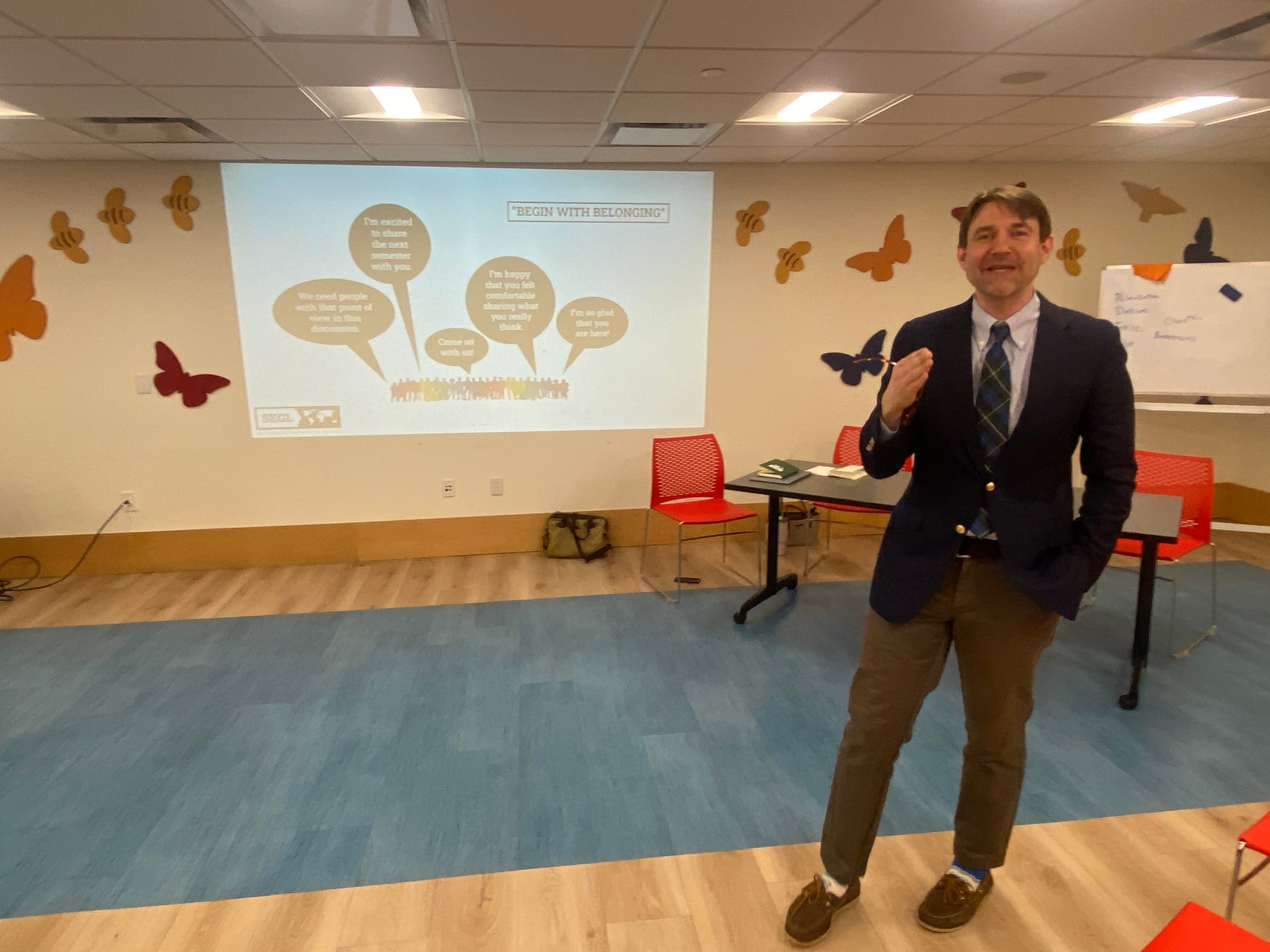
We also briefly chatted with Head of SEGL Noah Bopp just before he launched the evening’s activities. Asked how he got involved in the “We the Neighbors Initiative,” Bopp said, “Well, Komal [Bazaz Smith] and I are really old friends. She was part of a group of people who were supportive in various ways when I was starting the School for Ethics and Global Leadership. So I’m the founder and head of SEGL which is a semester-long program for high school juniors all over the country with locations in D.C., London, and Johannesburg. And the goals are to create American leaders who can be strong internationally wherein over time this issue of what we call ‘Growth Discourse’ has become more and more central to our curriculum. So Komal knows we’ve had lots of conversations about how to make things better that way.”
Asked how he felt about his invitation to host the event, Bopp said, “I’m excited. I’ve done this sort of thing a lot. And I know that it’s something that’s increasingly of interest to everyone in our democracy. I think there are various pendulum swings over time on various issues and the pendulum is swinging back toward, ‘We actually have to listen to each other. We actually have to be in conversation.’”
“So my presentation will lead us into the Four Pillars of Growth Discourse which is something we’ve used at the School for Ethics and Global Leadership intentionally for the last several years.... So, bringing people in from different sides of the Israeli-Palestinian Conflict, people on different sides of what’s happening in Iran, guest speakers that would be polarizing in different situations….We’ve done it with schools, we’ve done it with companies, we’ve done it with nonprofits in various ways. So each group is different and has different ideas.”
Jack Kreul, a senior at Meridian H.S., expressed enthusiasm about the event. “I think it’s a great idea. I think there’s not a ton of opportunities like this that I’ve seen or been able to maybe be part of. There’s a couple of things at school, but I really think this is the kind of thing we should be doing more of at school,” he said. “I think for the most part we’re sort of a pretty liberal community and I think most of the time people at our school will agree on most political issues, but definitely there are some times at school – and really more in the real world, or the outside world – where these skills will be necessary when you leave the Falls Church community.”
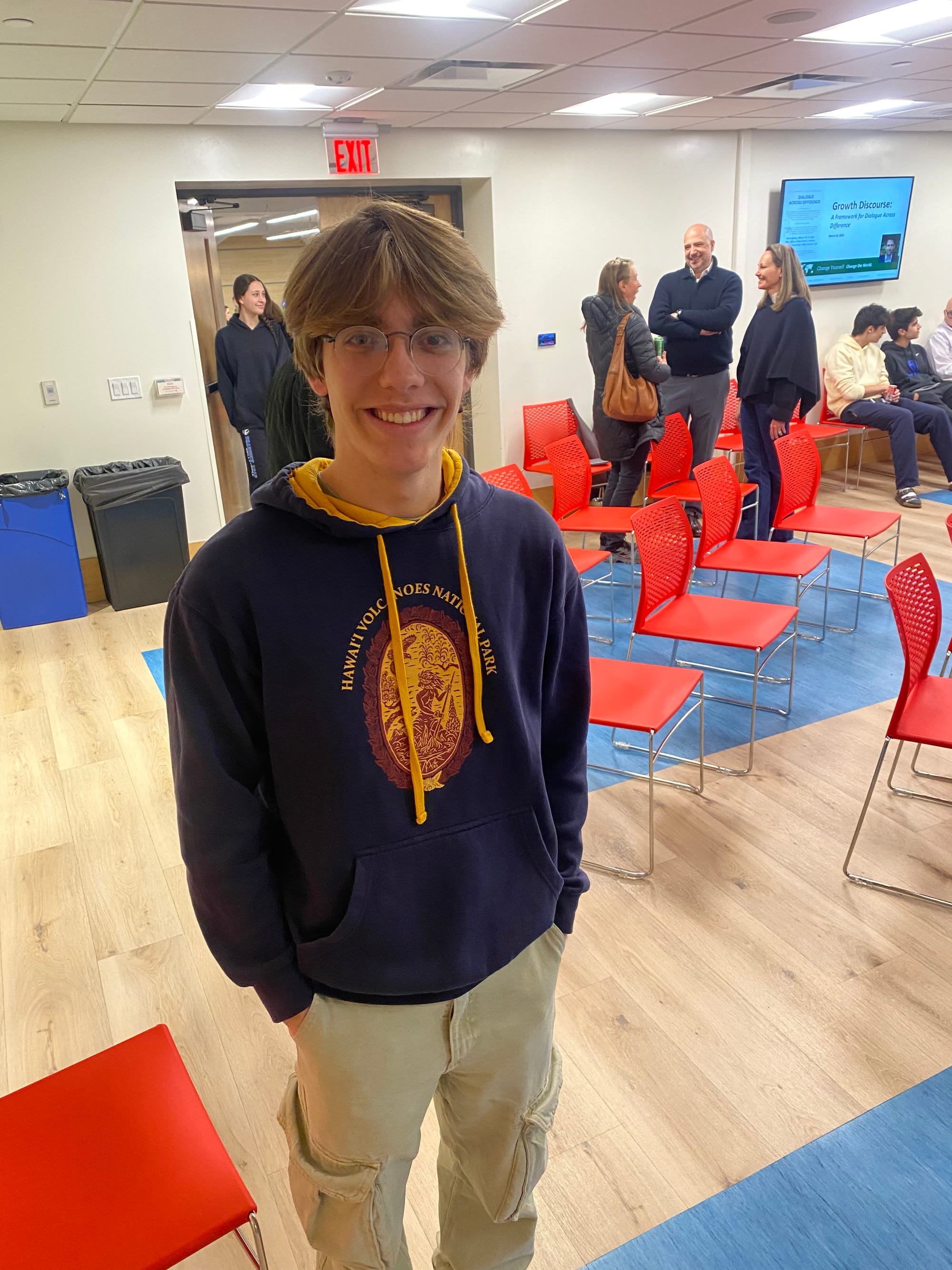
“I think it’s super important to bridge these divides, especially now,” Kreul continued. “I feel like people are getting really polarized with their political beliefs and I think it’s extremely important to talk with people and at least hear their opinions, if not agree with them.”
“Just want to read about why we’re here,” Bazaz Smith said to introduce the Community Conversation. “So, a healthy democracy depends on our ability to resolve differences with civil conversation…. Today, we are all confronted with a cacophony of voices. Yet it’s not the voices or topics that divide us. Rather it’s the skills we’ve built to address those differences. Because right now and in the future we all need to manage polarization."
"We need to think critically and we need to learn how to engage even with respectful differences. This is actually a skill. The work we hope to do in this initiative is about preparing youth and adults to constructively engage in a polarized world and make the world a better place.... so that our differences don’t lead to deeper divides, deeper isolation from one another, or worse.”
Noah Bopp then took the reins of the discussion. He noted with humor that many of the students in attendance might be in their seats because they were offered extra-credit by one of their teachers. From the crowd, Meridian student Gabe Ellis gallantly called out to cheers, ‘We all will get extra credit, but we came of our own accord!’ "
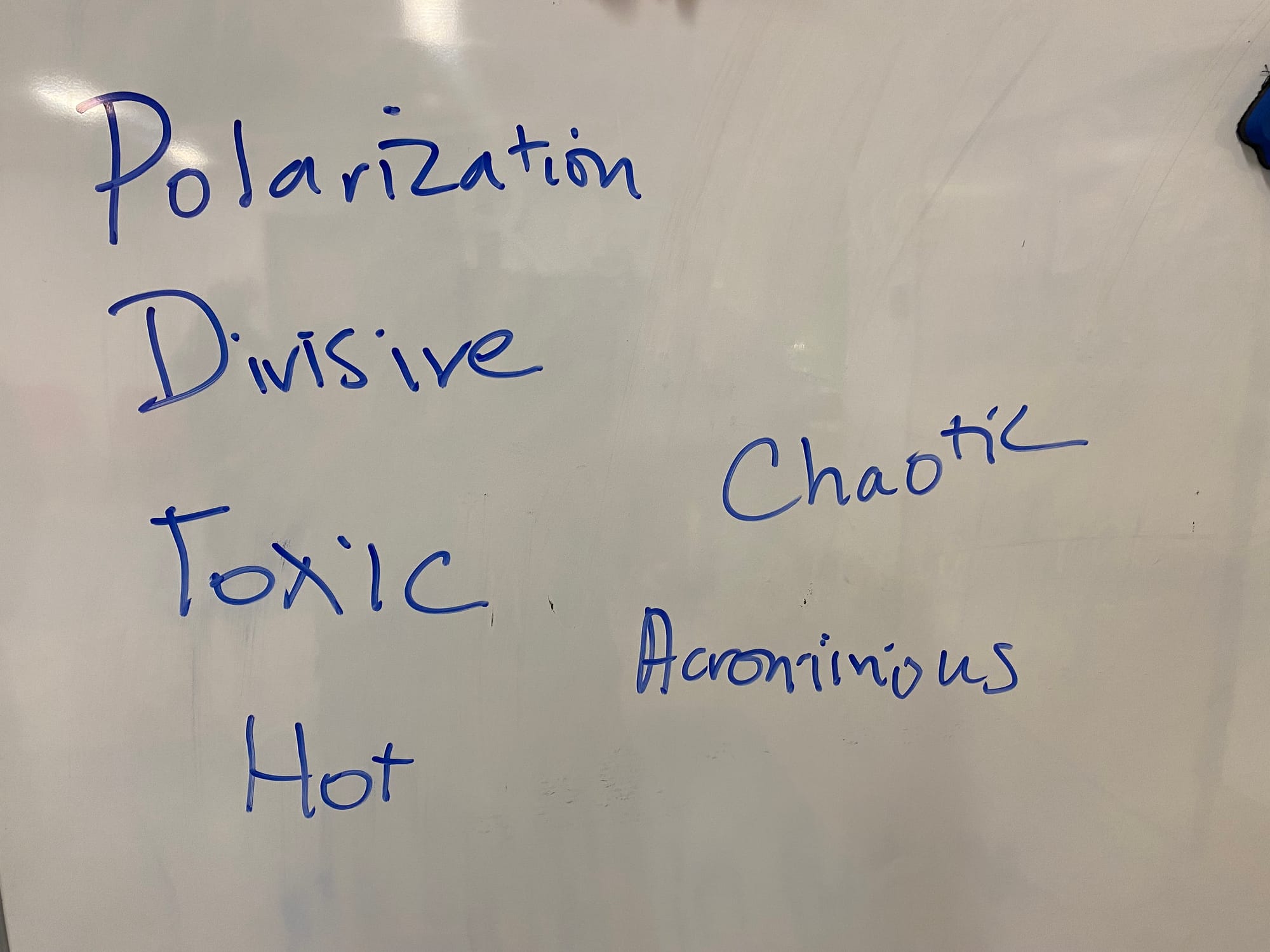
Bopp then asked audience members to “describe the state of American political discourse today,” and the words “Polarization, Divisive, Toxic, Hot, Chaotic, and Acrimonious” were written on the board.
Each of the panelists was then asked by Bopp to describe the issues in American discourse from their own points of view. Council member MaryBeth Connelly thoughtfully described her learning curve over her 12 years on the City Council, where she grew to understand how important collegiality and compromise are to resolving the City’s problems. “You actually have to ally with people whom you wouldn’t normally ally with,” she emphasized.
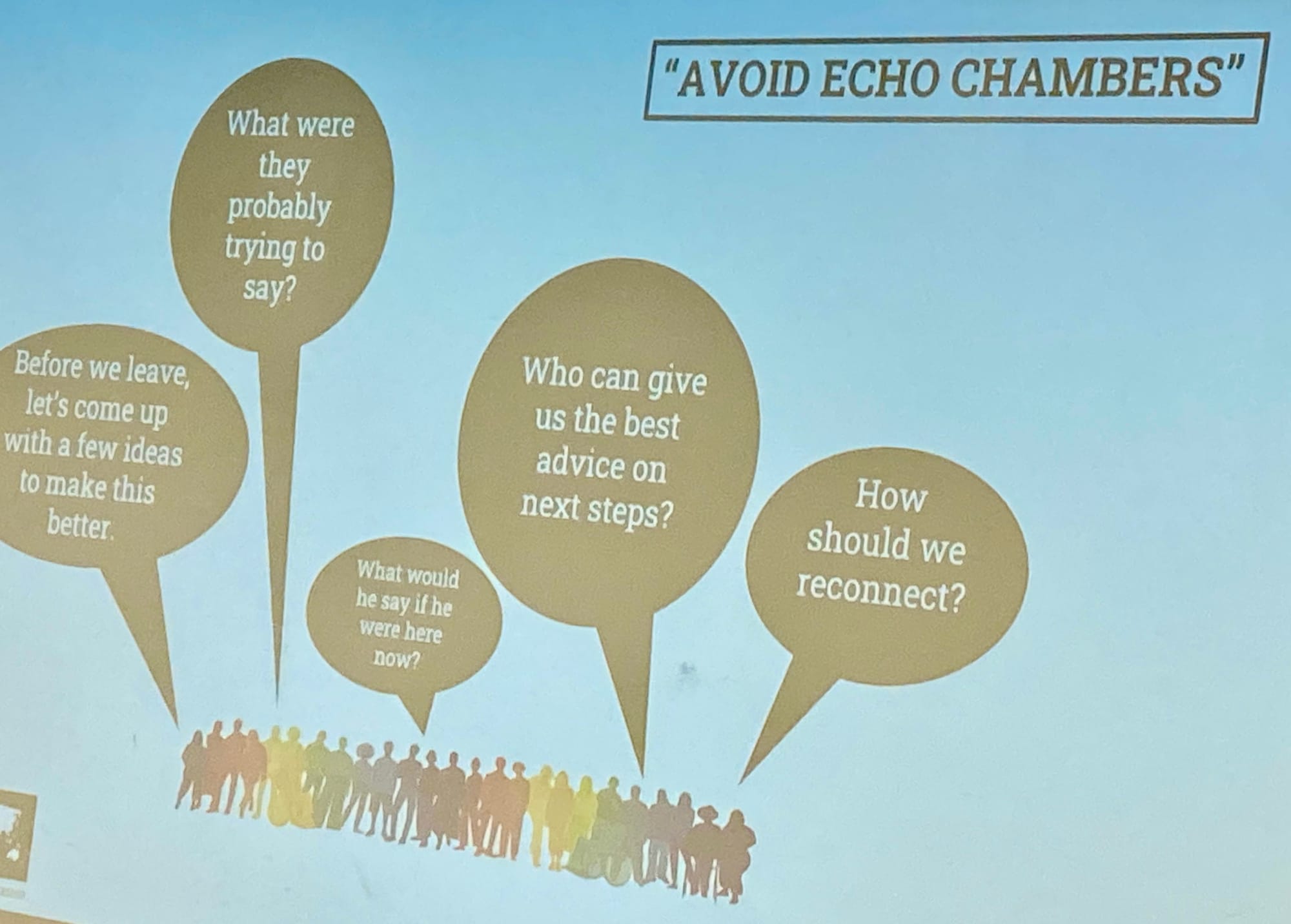
Meridian senior Cailyn Murphy said, “So I really think from my personal experiences as well as in school – I’ll use a TOK term – we’re often in echo chambers and a lot of the information we’re getting is that we do surround ourselves with people like us and so a lot of times we’re not really getting the other perspectives because we don’t really want to be hearing it. Also I know my social media is targeted toward what I want to see. So a lot of what I see on my social media is targeted just to my own echo chamber. And that can make it hard to see from other people’s perspectives.”
“I also think a big issue in schools is that rather than targeting people’s viewpoints, we target the person they are,” Murphy continued. “And I think that’s a large issue in politics right now – separating the person from the viewpoint…. And I think that really makes it hard to speak out in school and to really share your opinions, knowing that people might not like you for the person you are but for your viewpoint. So I think that’s a big issue, especially in schools that don’t have healthy discourse.”
Meridian Theory of Knowledge (TOK) teacher Jared Peet described the issues from an instructor’s point of view. “As a history teacher, finding a common set of facts we can agree upon is really challenging in this day and age and I think our shift away from a reliance on expertise has made that even harder…. Without that idea of expertise and a set of facts, and information, and reliable viewpoints we can turn to, it makes it much harder to have reasoned discourse.” He also stressed the importance of having dialogue as opposed simply to debate, so difficult conversations can bridge divides rather than result only in a winner and loser.
So, “How can schools and institutions address problems with civil discourse?,” Bopp asked. Peet stressed the TOK theme of the importance of having empathy to enable one to see issues from another’s point of view. However, he warned of the “danger of a single story,” as author Chimamanda Ngozi Adichie has described, where people’s perspectives can be reduced to one simple stereotypical narrative.
Senior Cailyn Murphy said with a smile that she was also going to refer to the “danger of a single story.” “I think it’s important to go beyond their single story and actually have a discussion where you say, ‘Oh, I might not agree with this viewpoint, but where is it coming from?,’ she said, while adding that she thinks students should be taught the skills of discourse in their 10th grade Government classes, as opposed to in their home rooms [Stable Blocks] where students tend to be less receptive.
Council member Connelly emphasized the “importance of finding common ground,” even with political adversaries, citing collective student success on Give Day initiatives, and in other areas “everybody cares about.” Give Day, she said, is “a really big project that all kinds of people with different views are getting together on for the good of something else, so you’re able to set aside whatever differences you have in class….”
Bopp asked the panelists to offer a personal story to help illustrate issues in civil discourse – “something that went really well or something you might do differently next time.” He offered his own example of his “pretty liberal” wife and their daughter baking cookies “every few months” for their Trump-supporting neighbors in Capitol Hill, and those neighbors returning the gesture kindly as well. ”In this little way, even though they know that we had a Harris sign in our front yard and we know that they had a Trump sign in their front yard, we can keep that dialogue going,” Bopp said.
TOK teacher Jared Peet recounted a humorous but insightful story where he asked his good friend Kevin why Kevin’s life seemed so much more humorous. Kevin had even told a funny story on the Moth Radio Hour. So Kevin asked Jared to “imagine if you’re getting on a plane and someone sits down next to you in the middle seat and they say hey to you. What are you going to do?” Jared thought he would “say hi and probably go back to listening to my music.” And Kevin responded, “That’s your problem. You’ve got to lean in. You’ve got to get curious. When the guy sits down next to you and says hi, that’s your opportunity to have a conversation.”
Later, when Mr. Peet was traveling to Chile, he happened to be taking a taxi ride with a Venezuelan driver just as news of the capture of Venezuelan leader Nicolas Maduro was coming out following American bombing attacks. So, despite worrying that the driver would resent Peet for being American, Peet “leaned into” the conversation and was pleasantly surprised by the driver’s affability. “It was like, ‘Oh, we can actually have a conversation about this and I’m learning a ton just by asking questions.’” he said. “And I think sometimes I just take that as an opportunity to just learn from people, to be a sponge.” By showing respect and humanity to others, all sorts of bridges can be built across differences, Peet implied.
Senior Cailyn Murphy described how she was instructed to look for college dorm mates based on their having similar political affiliations. But, she realized she was better off not counting people out just because of whom they might follow on social media or what political leanings they might have. “As I’m going to college I want to know more and try to understand where these people are coming from,” Murphy said. “And they’re coming from all over the country with different backgrounds, different stories, etc.’”
Council member Connelly then told a refreshing story of how she once formed an unexpected bond with an ideologically opposed Council member when they sat next to each other in a meeting and both “liked balconies” in multi-use projects and saw little reason to restrict them. So they began referring to themselves as the “Balcony Corner.” “So my strategy has always been to be super, super kind to those people and to sit and go and have lunch with them,” Connelly said. “And I came to realize there is no one on the Council whom I dislike, even if I don’t agree with them on many issues.”
Bopp asked the panelists how they navigate the question of proper limits to free speech. He offered that “if you have someone spraying a swastika on the wall we’d all probably say, ‘No, that’s not okay.’ But then he pointed out there are many gray areas.
TOK Teacher Peet described threading the needle in two difficult conversations. The first was with an old Israeli friend who questioned how the American government could permit pro-Palestinian speech on American campuses given that Hamas – the governing body in Gaza – is a designated terrorist organization according to the U.S. State Department. Peet said to his friend that even though he’s Jewish, the value of allowing the public expression of even the most offensive speech – as in the case of the National Socialist Party of America v. Village of Skokie, Illinois (1977) – serves as a cornerstone of American values, though such expression, of course, “would not be permitted in my classroom.”
Peet also emphasized that students should be allowed to make a mistake and sometimes “say dumb things” in class, as is natural, because if they’re not allowed to do so, they won’t learn important lessons about what’s appropriate and will be less inclined to participate, thus damaging rather than facilitating discourse.
Cailyn Murphy (12th) commented that many conservative students at Meridian might feel muzzled given the liberal leaning of the school. And liberal students might feel uncomfortable hearing views that differ from their own, especially on hot topics like abortion rights. “I think frequently people will say something the majority of people just do not agree with and it’s like that person is just shunned…. But I do think they should be allowed to have that viewpoint,” Murphy said.
“At the same time I think there are people who would go wild if we didn’t have restrictions on what we can and cannot do,” Murphy advised. “For example I know a swastika was drawn in the elevator and I do think without restrictions on doing that, people just aren’t going to learn that there are just some things that are not okay.”
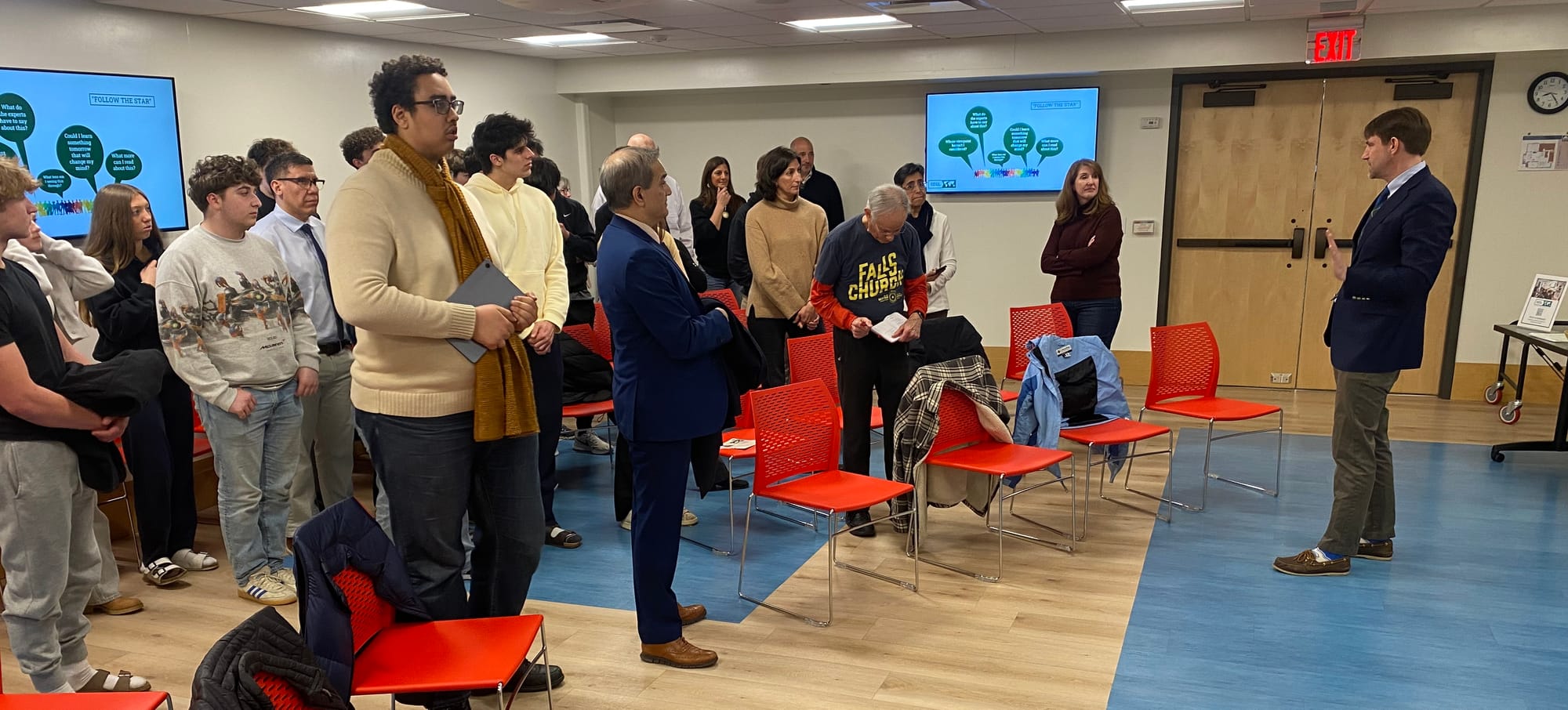
In the workshops, members of the audience were then asked to stand on the side of the room that corresponded to their responses to a range of four "spectrum questions,” offering diametrically opposed views on a given prompt. For example, where would participants stand on the following spectrum?: “When having difficult conversations about identity, the only thing that matters is our intent.” Versus: “When having difficult conversations about identity, the only thing that matters is our impact.”
After audience members took their places along the spectrum for each question, Bopp asked participants at either extreme and in the middle to describe why they chose to move to that spot. The ensuing conversations then sparked fresh dialogue as participants wrestled with their choices. The participants, young and old, appeared to find the exercises revealing, challenging, and informative.
Following the workshops, we spoke with Meridian senior and panelist Cailyn Murphy, who told us she will be off to the University of Miami in the fall. “I’m really glad I got this opportunity. I was a little bit nervous, but was still really excited, and this is something I want to continue through college. I’m doing a major and a career in politics, so this is really interesting to me,” she said. “I want to see a community where we can listen to other people’s ideas and not feel so targeted towards them, so I do think this has a lot of real world applicability.”
Finally, we spoke with participant and Founder of the Citizens for a Better City (CBC) Hal Lippman about his views of the Community Conversation. “I totally support what Komal and Olga have been doing and passing it along,” he said. “But, I told them, I’m skeptical because real situations in the world are what we have to deal with.”
Lippman cited the 2017 “Unite the Right” protests in Charlottesville to illustrate the problem of how one has “civil discourse” with neo-Nazis intent on doing harm. “As it happened in Charlottesville, a protester is walking by and doing a protest and has a torch in one hand and an AR-15 in the other hand and he’s walking by where you happen to be – it’s a synagogue – and dot, dot, dot.,” Lippman said. “It makes me wonder about, when the rubber is meeting the road, how are you able to step back when there are such extremes involved?”
Question for the audience: Do Lippman’s reservations merit respectful discourse?
For more information about the “We the Neighbors Initiative,” contact Komal Bazaz Smith at: komalbazassmith@gmail.com.
By Christopher Jones

Member discussion