
The Post's Phony 'Odyssey' Coverage
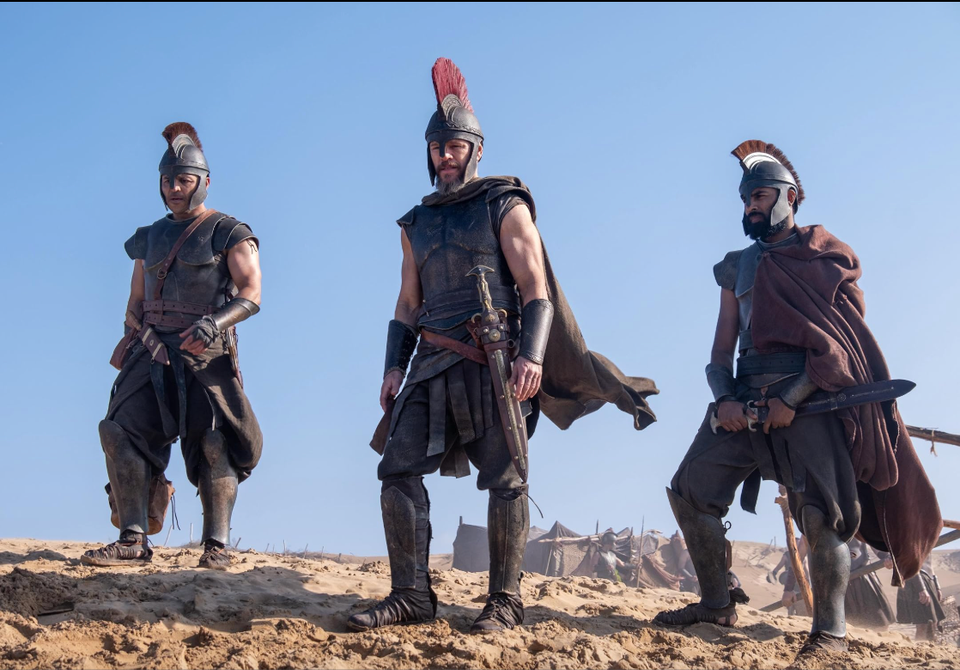
Seriously, I'm embarrassed for The Washington Post. And disgusted by its obsequious, worshipful, non-critical hyping of Christopher Nolan's recent film "The Odyssey."
Whether Nolan's movie is good or bad is not the issue here; it's the question of whether Post subscribers are reading actual film critiques. What's an "actual film critique"? It's a reviewer watching a film closely with a trained, critical eye, and weighing its positives against its negatives, from a variety of angles, to make an overall judgment about its quality and then writing with nuance about their conclusions.
But what has the Post delivered? A near daily barrage of over-the-top "Odyssey" propaganda, seemingly designed to boost box office receipts.
And by my count there has not been a single word of criticism against the "Odyssey" – either before or since its official July 17 release . Only one critic, Spencer Klavan (see below) gives a nod to the notion of criticism, but his straw man argument is: that while many viewers are bound to disagree with Nolan's interpretation of Homer's epic poem, in the end, Nolan's vision is still powerful. That's it.
Let's look at a few examples from the Post.
Some Over-the-Top Samples from the Post:
July 16, Opinion page: In 'The Odyssey' Will Overwhelm You – and Not Only with Spectacle, Post author Will Leitch, of the Fanfare with Will Leitch newsletter, proclaims. "Christopher Nolan proves epic-scale, old-school Hollywood blockbusters aren’t gone yet."
"The movie industry appears to have been turned entirely upside down this year," Leitch observes, as some lower-budget films have won big at the box office while other "expensive productions have fallen short."
"Which is why there remains, truly, no one like Christopher Nolan," Leitch writes. "The most maximalist of blockbuster filmmakers, Nolan knows only one way to make movies: as big as possible. His fantastic new film, 'The Odyssey,' was shot entirely with Imax cameras and has a cast filled with just about every major movie star you know (and many you don’t), the most ambitious possible approach for a writer-director who tasked himself with the simple job of adapting one of the foundational texts of human communication."
"But what’s remarkable about Nolan is how his movies, though they have massive scale, are always deeply personal, even eccentric, and feature purposefully labyrinthine timelines and narratives," Leitch fawns. "He expands and contracts all the tools of Hollywood epic filmmaking, challenging his audience while trusting them to be smart enough to follow along on his journey. That he is one of the most financially successful filmmakers on the planet is a terrific argument [italics added for ridicule] for that trust being rewarded. His movies are huge but also intelligent.... In an age of wild transition in our popular culture and entertainment habits, Nolan makes you believe in movies — and their audiences."
"'The Odyssey' is Nolan’s most expansive film, quite a thing to say about the guy who made 'Oppenheimer,' Leitch continues obsequiously. "It tells the timeless story of Odysseus (played with sturdy, the-rock-on-which-Nolan-builds-his-church intensity by Matt Damon) attempting to get his men home from war and return to his wife, Penelope (Anne Hathaway), and son, Telemachus (Tom Holland). Everything you remember from that humanities class is here, from Scylla and Charybdis to the Sirens to the Laestrygonians to a truly terrifying Polyphemus the Cyclops, who, in Imax, is basically the size of a skyscraper."
"Truly terrifying"? Were we watching the same film?
Nolan "uses every ounce of his budget to provide the sort of epic-scale, old-school Hollywood blockbuster that studios hardly remember anymore, let alone consider bankrolling. The film is a reminder of one thing American studios have always been able to provide: spectacle. The pure brawn of its bravura filmmaking, combined with Nolan’s trademark craftsmanship, is a reminder of what studios are capable of when they swing big. It will overwhelm you in the best possible way."
Oh, Swoon!
"But Nolan has more on his mind than just spectacle. Like 'Oppenheimer,' 'The Odyssey' is in many ways about the hubris of man, about how the more we convince ourselves we have conquered nature and the gods, and believe that we no longer need to look to history to understand the future, the more chaos and destruction we wreak....."
"Nolan’s last two films, though they are both period pieces, feel vividly current and desperate to find some way to save the world before we eradicate it entirely," Leitch says with gravitas. "His films are the product of a great man’s ambition — his own — but warn against overreach and ego: He’s a man who sees the world burn and worries whether it can be stopped.... 'The Odyssey,' for all its darkness, still has hope. There is a moment at the end of 'The Odyssey' in which Nolan shows something I’ve never seen in his many, many great films: an earnest belief that, if we change our ways, we really can sail off into the sunset. It believes in us, in spite of itself."
Yes, and "sailing off into the sunset" is possibly the number-one film cliché?
"That such weighty, existential issues can not only appear within a blockbuster but provide the film its moral backbone speaks to what makes Nolan special," Leitch continues unwaveringly. "He uses this incredible canvas to tell stories about our time, about man’s cruelty to himself and everything around him, and about man’s ability to change — to make a difference, before it’s too late. He is a singular filmmaker who leverages the tools of Hollywood filmmaking to tell stories of humanity — our strengths, our faults, our follies, our resilience. His films, and especially “The Odyssey,” remind us of what we are capable of, their scale evidence of the power of vision, ambition and careful, workful craftsmanship. He will make you believe in movies again. He will make you never want to stop."
Oh, please, don't stop!
Friday, July 17, Weekend Section: The full cover page of the Weekend section splashes a Universal Pictures promo shot of Matt Damon as Odysseus and Zendaya as Athena for a story about "An Epic for the Ages," teased by the line "It's not just visual and sonic sweep that makes Nolan's 'Odyssey' a towering feat." Inside, the film is granted four stars above a heroic Matt Damon leading-the-warriors photo. The story – purchased from Tribune News Service – is jump titled, "A Masterpiece of Mythic Proportions," its subhead pronouncing: "Nolan, at the height of his powers, takes us on an entrancing journey."
The first paragraph of the story suggests that Nolan's filmmaking career "all seems to have been leading to this," mentioning 10 of his preceding films. "...Nolan manages to fit his every obsession, every thematic preoccupation, and every bit of jaw-dropping visual and sonic spectacle that can be conjured into every supersize frame of film," the review gushes.
"What makes Nolan's vision of 'The Odyssey' so entrancing is the sheer scope, scale and beauty of it," the over-the-top review says. "Like an army, [Nolan] marshals his tremendous resources, talent and an army of artists in service of conveying his message to a rapt audience.... It's the immediacy and tactility that makes this adaptation arresting; the seat, size and sound of it.... On his grandest scale yet, Nolan reckons with the dead, face-to-face, and asks us to do the same, like Odysseus. Putting all of that spectacle behind this simple but powerful message – it's nothing less than glorious."
Hurl.
July 17, Opinions Section: Host of the "Young Heretics" podcast, Spencer Klavan continues the obsequiousness, in his musing, "Nolan's 'Odyssey' Makes the Controversies Evaporate." Klavan begins: "Christopher Nolan's 'The Odyssey' is a gorgeous rendition of a story that never gets old. No adaptation could possibly capture the full scope and intricacy of Nolan's source material, the ancient Greek epic poem by the enigmatic figure called Homer. But Nolan reimagines many of the poem's most compelling myths and picks up on some of Homer's key themes. The movie... will probably delight most viewers...."
"Nolan is captivated by the story's set pieces, which he puts on screen with exhilarating panache. He doesn't shy away from the supernatural; the scene in which Circe turns Odysseus's crew into pigs is a marvelously demented highlight. Homer's dramatic grandeur comes through in sweeping ocean panoramas and imposing palace interiors.... ["The Odyssey"] is at once a deeply psychological character study about self-understanding and a grand adventure story about bringing order to a fallen kingdom.... If Nolan has done justice to some elements and lost sight of others, he has done the most that anyone can do.... Nolan has produced a lovely version for modern times...."
It's the "most that anyone can do," so just get over it.
July 17, Style Section: On page 1 of the Style Section, we see, "Readers Embark on Epic 'Odyssey' Crash Course: It's a Scramble to Finish Homer's Work ahead of the Release of Christopher Nolan's Film." The article explores the wide proliferation of book clubs and online discussion groups devoted to reading "The Odyssey" before they see Nolan's film.
Visiting a Brooklyn bookstore, author Grey Battle writes, "You can now find Homer's circa eighth-century B.C. epic displayed in a section aptly named 'Flying Off the Shelf.'"(!) Battle profiles a 27 year-old bookseller who has transformed her "Survivor watch group" into an "Odyssey book club." Turns out, "Sales have spiked" for Odyssey translator Emily Wilson's acclaimed version of the epic poem, which Nolan claimed inspired his own film vision – a film whose script Wilson has since denounced. "Sales for the trade paperback edition are up 40 percent since last year, with domestic sales across all formats surpassing 1 million copies...."(!) Some book club members "decided to read multiple translations ahead of the film." Even though "Odysseus is not me," one female reader said, "I'm seeing myself in him." Another curious student, Vashi Armenikus, is "reading along with more than 5,000 subscribers to his Genius & Ink newsletter on Substack, where he hosts read-alongs of classics.... Nolan's film is one of the reasons Armenikus chose 'The Odyssey'...."
For one book club that completed its reading, it was time to see Nolan's film! "Sunday was their last Odyssey meeting. The group will soon watch the movie premiere in 70-millimeter Imax. 'We had to fight a war to get our tickets...,' one book club leader exclaimed. "The Imax showings sold out within 90 seconds, and the AMC website crashed for two hours. But one member completed the odyssey by taking a train to the theater to buy six tickets in person."
July 18, Style Section: The headline blares: "A TRANSFORMATION JOURNEY," with the subhead, "The best way to prepare your brain for Christopher Nolan's new adaptation of 'The Odyssey' is not to prepare at all." Writer Monica Hesse opens with a humorous confession that, notwithstanding all her schooling, she had never actually read a translation of Homer's work, despite her often using the term "Odyssean journey." After ordering her Coke Zero, she watches an early screening of Nolan's film, reserved for press potentates.
On the jump page, with a Universal Pictures photo of Anne Hathaway as Penelope and Tom Holland as Telemachus, Hesse's story – taking up nearly the entire page – continues under the title, "A Captivating and Unexpected Epic." Referring to director Nolan, Hesse writes, "The Odyssey" is "brought to you," by the "writer-director responsible for such mind-bending works as 'Inception,' 'Memento,' 'Intersteller,' and 'Oppenheimer.'
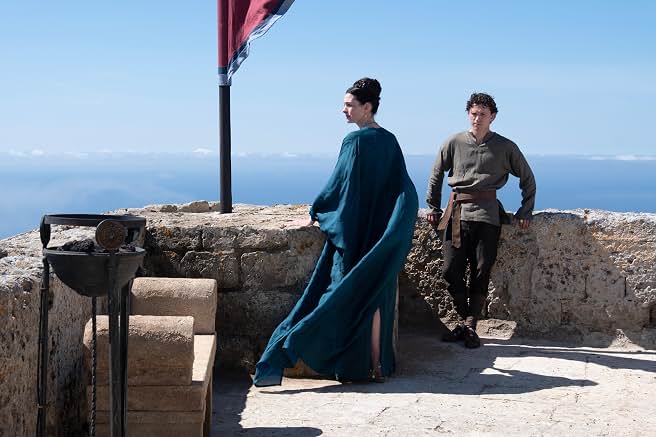
After a lengthy film synopsis, Hesse launches her epic narrative journey. Prepare for star-struck, unbridled enthusiasm: "As I walked into the screening, the woman ahead of me remarked that she hoped it wasn't 'too Christopher Nolan-ish,' but truly, why would you go to a Christopher Nolan movie if you wanted anything else? This movie bends time, flashes forward and backward, nestles stories within stories, piles ambition on top of ambition, wrangles every esteemed thespian you forgot you loved.... and is three hours long. Nolan is known for using classic effects rather than CGI and this movie is, stunningly, no exception: real Greek caves, animatronic puppets, massive water pools, everything a visual feast."
But in the film, Nolan couldn't make any of the gods appear god-like?
Hesse doesn't stop there. "'The Odyssey' is – and let's be serious movie people for a moment – absolutely astonishing.... For a director who has made his bread and butter on extremely masculine movies, Nolan displays incisive curiosity and respect for all of the women of 'The Odyssey'.... This is the kind of movie that turns out not to be what you think it's about. Where information is revealed that radically changes your understanding of the story, in a way that feels earned rather than like trickery....
But even this isn't enough fawning for Hesse. "After sitting in the theater, gobsmacked as the credits rolled, I felt strongly that I had come into the story in exactly the right way: completely ignorant.... All of you out there who have apparently been trying to read 'The Odyssey' before you see the movie – stop that. It's not necessary...." To conclude, Hesse confesses that she is now about halfway through Emily Wilson's "The Odyssey" – "I love the 'Odyssey,' she beams. "It's been my favorite book for 3000 years....," she writes coyly, suggesting that Nolan's film is the perfect 'Odyssey' for our age and every age.
July 19, Arts & Style section: On page 1 of the Post's Arts & Style section, an AP article, "The Odyssey of Bringing 'The Odyssey' to the Big Screen," begins: "Christopher Nolan has never been afraid to dream a little bigger. It's almost a calling. With every film, he's pushed himself and the medium further – playing with form, story-telling, visuals and audience expectations to create lasting cinematic spectacles. A student of Hollywood history, the Oscar winner is always looking to fill gaps in cinematic culture and show audiences something they haven't seen before: 'The Odyssey,' he realizes, was a massive one. All of Nolan's films are epics in their own ways. But for 'The Odyssey,' he knew he had to do something fitting of the Homeric poem and its foundational place in Western culture, something worthy of the biggest screens and the resources it would require...."
On the jump page, the article continues with the header, "How 'Odyssey' Director Made 3,000-year-old Tale Feel Fresh."
"The Odyssey was an epic undertaking – the hardest film anyone involved had ever made....," the article declares, as all of the exotic locales for shooting are highlighted. ".... Iceland’s black sands, shot in the midnight sun, are used for Hades and the island of Favignana, near Sicily, played Ithaca, where much of the cast and crew hiked 45 minutes every day before work to reach a 15th-century castle, 1,030 feet (313.9 meters) above sea level." Wow, a thousand meters!
Subheaded "Odyssey-fever," the piece concludes with more out-of-control hype. "Nolan productions always inspire a certain amount of hysteria, but excitement for 'The Odyssey' reached a fever pitch," it says. "Initial screenings for the 70 mm IMAX showings — his favorite format — sold out in under an hour a year in advance. When all showtimes went on sale last month, ticketing sites crashed. High profile locations.... are virtually sold out for weeks, and scalpers on eBay are attempting to sell tickets for more than $500. But the 70 mm IMAX screens account for only about 32 theaters out of thousands in North America...." OMG!!

July 20, Style Section: Beneath a color collage of personalities from Nolan's films – with his own god-like visage at top center – we encounter, 'The Ambitious, Diverse Beauty of a Christopher Nolan Movie," by Post writer Gene Park. Now it's time to continue the film shilling, by ranking – Buzzfeed style – all of Nolan's 13 films to date.
Nolan's "filmography touches all the bases, from the indie to the epic. As 'The Odyssey' plays to packed houses, here's how we think they rank,' the subhead says.
Breathlessly, Park begins: "In an era of entertainment increasingly dependent on franchises, Christopher Nolan has turned his name into one of them. He turned a procedural about a scientist into a billion-dollar box office blockbuster. He’s built a career on creating crowd-pleasers that challenge, overwhelm and find a life of their own beyond the weekends or summers they debut and dominate.... Like Alfred Hitchcock before him, Nolan makes intellectually ambitious and beautiful films that serve as mass entertainment even as they push the limits of cinematic achievement. Today he is a singular talent."
Even the Alfred Hitchcock comparison doesn't suffice....
".... 'The Odyssey' is the richest fantasy epic from Hollywood in at least a decade, with visuals that evoke the greatest epic films. Nolan’s architectural precision and emotional ambition move in lockstep, resulting in what feels like his most complete project with the most satisfying third act of his career."
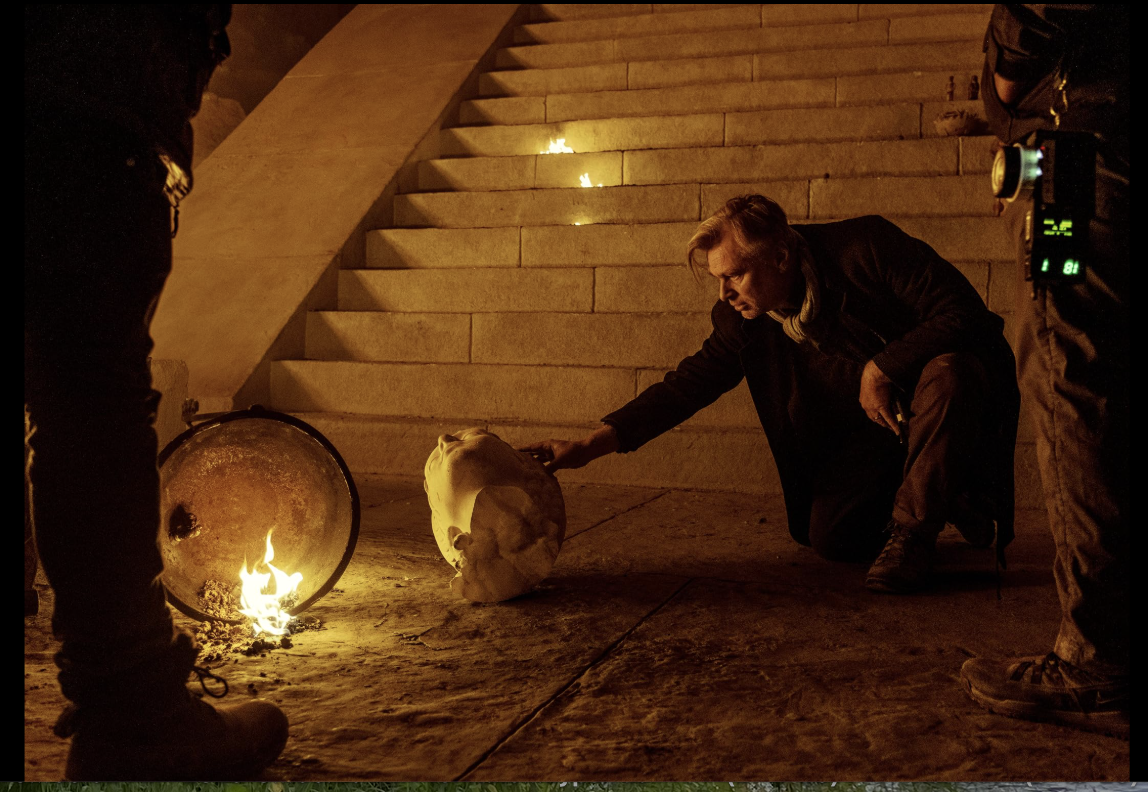
July 22, Style Section: In another outsourced piece, this time from the Los Angeles Times's Josh Rottenberg, we're now to explore "How Nolan's 'Odyssey' Took a Different Direction from Homer's."
Rottenberg begins his Buzzfeed listicle-style piece, "Eight of the biggest ways Nolan's 'Odyssey' departs from Homer's," by suggesting that since Homer's epic poem is so sprawling, only a director of Nolan's genius could possibly do the "serious re-thinking" required to channel this – the most essential story in the history of Western literary canon – into a "three-hour Imax blockbuster."
No way could Kubrick, Scorsese, Coppola, or Spielberg, do that!
While Rottenberg's Eight Ways are indisputable, he simply must conclude with the highest praise for Nolan's vision: "It’s Nolan’s final way of connecting Homer’s world to our own. Whereas the poem ends with order restored, the film leaves history caught in an endless cycle of collapse, rebirth and forgetting."
July 23, Style Section: On page 1 of the Style section, Monica Hesse returns to the Post's increasingly tiresome Odyssean praise machine in her "Screens" column, "700 Post Readers Emailed Me about 'The Odyssey.' That Speaks Volumes."
After tempting readers to contact her if they were interested in discussing linguistic tales in Homer's 'The Odyssey,' Hesse was simply overwhelmed by the crushing volume of messages she received!
"Lawyers wanted to know about the differences between oral and literate poetry. Neurosurgeons wanted to know. Teachers. Former classics majors, current stay-at-home dads, grad students, stepdaughters, grandpas, chefs, autoworkers, inquisitive readers from seemingly every state in the union and several foreign countries. Since I’d promised to write back to everyone directly, I wanted to write back to everyone directly, and I have just emerged from 16 hours of doing that."
"Seven hundred of you wrote to me because you were curious to know the things we know about the art of reading and storytelling, and that is, frankly, magnificent. But! The main reason I’m back here is because of everything you all also told me about your relationships with 'The Odyssey.' Your tortured, blissful, complicated relationships. Your senses of your intellectual worth. Your memories of skimming or skimping."
"Some of you had read multiple translations," Hesse continued. "The adventures of Odysseus became your children’s bedtime stories, comfy as a blanket. But some of you had read it in eighth grade and forgotten everything except the teacher who assigned it to you. And some of you, either finding it too daunting or fearing it too boring, had never even opened it. I had never read it either, and this was part of the point of my column: you don’t have to read 'The Odyssey' before you see 'The Odyssey.'
".... And, as for feeling as though you should finish [the book] before seeing the movie? Eh. That sentiment is an insult to books. It treats them as a punishment, something to be endured or slogged through. And it treats the movie as a reward – something you earn after poring over a 5,000-year-old technology."
That's right – widest possible box office audience – throw away those musty tomes and go see Nolan's masterpiece right away!
But this is not enough...
Hesse propounds the same hyperbolic extolment for four more paragraphs. Too embarrassing to summarize, they begin: "What if the movie is not a capstone but an invitation? What if the movie is the thing that makes you curious about the poem, and the world in which it was written?.... What if the movie is the thing that makes you want to know more, rather than an assurance that it’s okay to know less?"
In that case, I'm glad to be learning less and less by reading the Post.
July 24, Style Section: Nearly the entire cover page of the Style section is taken up by, "The Odyssey of Choosing a Screening."
This time, two different Post writers take on the hype. Jade Tran writes, "The Adaptation of Homer's Epic Poem is Being Shown in Various Formats. We're Here to Guide You on Your Ticketing Voyage." And Shane O'Neill writes, "A 2:40 a.m. Showing of the Movie in 70mm Imax? I Took Up the Gauntlet. Here's How it Went."
"....Even before opening day, social media was flooded with advice about the 'right' format to watch the 172-minute film, and even more opinions arrived after audiences began their own odyssey to the theater," Tran writes. "... because 'The Odyssey' is the first movie filmed entirely with Imax 70mm film cameras, choosing where and how to watch it requires a little more thought. Here's a guide to finding the best option for you..." Hmm, sounds a little Buzzfeedy again.
Tran has three pieces of advice. For Imax 70 mm, "If you're a true cinephile, this is the gold standard. Only 41 theaters worldwide.... can project films in this format, with just 25 in the United States. That scarcity alone has sparked plenty of backlash. But this is how Nolan intended audiences to experience the film...."
Yeah, right. It's called "artificial scarcity" people!
This format is "the closest you'll get to feel like you're sailing alongside Odysseus.... For many movie snobs, if it was shot this way, it should be seen this way...."
For Imax, it's "one of the best ways to watch the film and is much easier to find...." Plus, it's more affordable. With a "plethora of Imax theaters around, you’ll still get an excellent viewing experience without forking over an entire paycheck."
Dolby Cinema is also a "strong alternative," known for its "deep blacks, vibrant colors and high-contrast picture, which makes it an immersive way to experience movies.... If you're sensitive to loud movies, [however], you may want to choose another format (no matter how many seats are open), as viewers claimed this was the loudest movie they’ve ever seen."
Wow, the loudest e-ver!
July 29, Style Section: Outsourcing again, this time to AP's Karel Janicek, the Post continues with its slavish devotion. Janicek was dispatched to Czechoslovakia, apparently, to find something – anything – more to say about Christopher Nolan's blockbuster extravaganza. Entitled, "70mm Imax 'Odyssey' Draws Purists to Prague," Janicek explores how film fans, apparently, are "flocking" to the smash hit "from about 15 European countries."(!)
"With Christopher Nolan's highly anticipated 'The Odyssey' recording impressive sales around the globe, thousands of Europeans have used it as a new and unexpected reason to visit Prague. The Czech capital has a movie theater that's among the few dozen in the world equipped with the coveted 70mm Imax screen to watch the first feature made entirely with Imax film cameras."
Accompanying all this global hullabaloo, a color photo of an all-Euro audience looking up at the awesome screen!
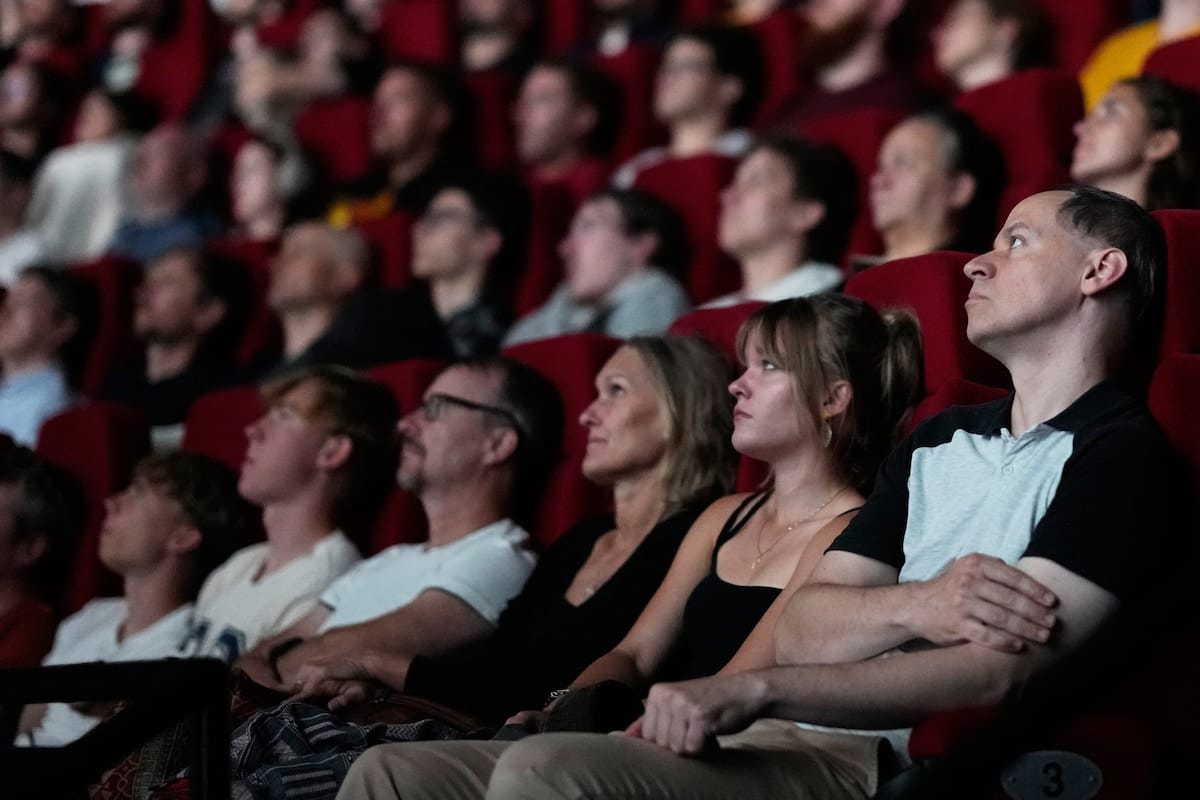
"Everything was great. It was a great movie," one Polish viewer dishes giddily. "To meet massive demand, the Prague Cinema City location offers four to five screenings a day...."
Can the Europeans even keep up?
"....Daniel Jung drove with his two teenage sons, Felix and Leo, for three days from Norway through Denmark and Germany, 'just to see this movie....," said Felix. '....We had the very best seats. Leo said....
"....I will always remember this experience," Leo added. "Felix said they had a good time on the way, visiting some places in Germany, but it would be worth it even if they just drove straight there."
Of course, no negative responses are included in the article, even though Europeans are well-schooled in Homer and basically invented art criticism of every variety.
While the Post has continued to churn out the lavish praise for Nolan's 'Odyssey," there are just too much examples to continue highlighting how obsequious it all is. Could it be that the Post's owner Jeff Bezos has grown accustomed to obsessive flattery and sycophantic deference?
By Christopher Jones
By Christopher Jones




Member discussion