
F.C.C. School Board Hones New AI Policies Toward 'Human Judgment'
Don't count human judgment out just yet!
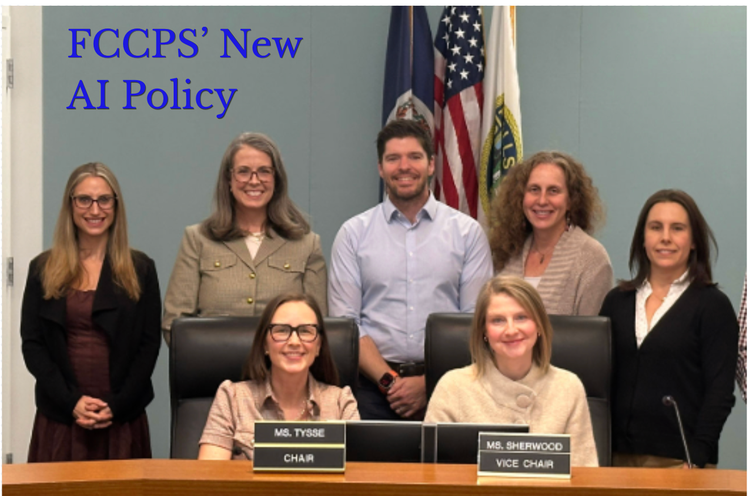
On June 11, FCCPS announced that the City School Board gave on June 9, "first-reading approval to a new artificial intelligence policy, refining the language so that decisions on grading, discipline, and placement must rest substantially on human judgment, with consequences for misuse written into the student Code of Conduct."
The Falls Church Independent wanted to provide some background and apprise our readers of the highlights and contours of the Board's dialogue in its June 9 meeting. We were curious to see if the Board is moving steadily toward a consensus position.

Background: The 'Earthquake That is AI in the Classroom'
Just this past Wednesday morning June 17, the 'The Daily' podcast from The New York Times tackled issues of generative AI in the nation's schools in their story The Battle Over A.I. in the Classroom. "With the school year ending, educators and parents all over the country are taking stock of the earthquake that is AI in the classroom.... There are concerns about artificial intelligence’s risks to kids’ learning and critical thinking, and tech companies are pushing to get chatbots into schools."
"Not only are there 'massive concerns about cheating' due to AI in the classroom, said Times tech reporter Natasha Singer, but there are major "concerns these AI tools could pose serious risks to kids’ learning [and] critical thinking, so that’s part of what the fight is about. And at the same time, you’re getting this massive push from tech companies – like Google and Microsoft and OpenAI – to get their chatbots into schools."
"....So one of the [questions] is, [will generative AI] misinform students, and are students not going to know?," Singer continued. "The second thing is you’re basically offloading human tasks to a bot. And if you're a child or a student who doesn’t know how to think critically yet, or who doesn’t know how to use research, or doesn’t know how to analyze a text passage yet, then it’s both hindering the development of your own human skills and also creating this result that seems human-ish. Human-esque."
'Starting at the High School:' Steps Taken on AI at Meridian
In December 2025, we reported on Meridian High School's attempts to grapple with the AI Earthquake:
"At Meridian High School in the City of Falls Church, Principal Peter Laub, and IB Diploma Program Coordinator Josh Singer hosted 'From Chalkboards to Chatbots,' a Dec. 11 Parent Coffee with a panel of teachers and students, designed to provide attendees with, as Principal Laub described it, a 'state of the state' on 'What the reality [of AI use] is in the schools,' what students and teachers are experiencing with it, and what the dialogue on AI with the School Board and the community 'looks like'?"
“'This session provides valuable insights as our School Board develops comprehensive AI policies for Falls Church City Public Schools,'” FCCPS wrote to describe the forum. 'Whether you're a parent wanting to understand how AI affects your student's education or a community member interested in educational innovation, this conversation offers authentic perspectives from those experiencing these changes firsthand.' "
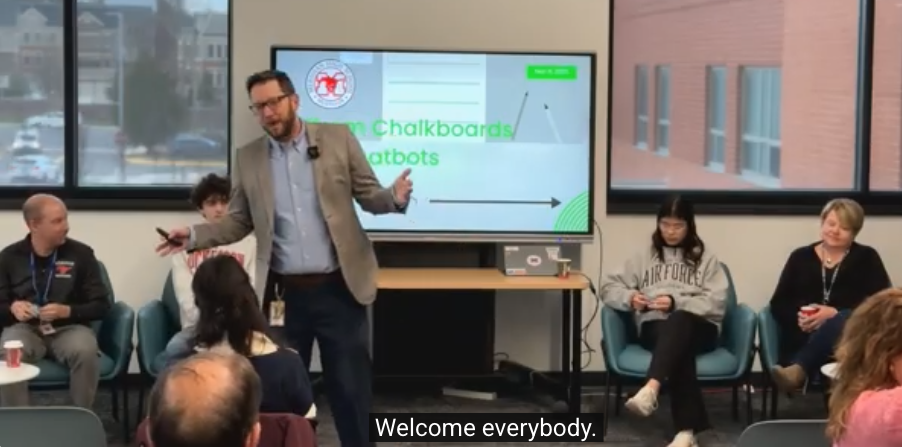
"'The panel discussion reflected well on Meridian High School,' our story continued. 'Over the 57-minute discussion, panelists exhibited deep thoughtfulness, open-mindedness, and strong understanding of the challenges and opportunities posed by Gen AI in the school system. By posting the full session to YouTube – including a few critical remarks from attendees and students – FCCPS is making good on its commitment to 'transparent communication about emerging educational technologies.'"
For the rest of the story, including the panel discussion, see our piece below:
 Christopher Jones
Interestingly, one issue with AI in the schools that surfaced in Meridian's 'From Chalkboards to Chatbots' discussion that was not addressed in Wednesday's The Daily podcast: students' displeasure with receiving generative AI feedback and grading from teachers.
A New School Superintendent Committed to Updating AI Policies
After the FCC School Board hired Terry J. Dade as the new Superintendent in May, 2025, Dr. Dade re-confirmed his commitment to reviewing and updating the City's school-wide AI policies over the course of the following 2026/2027 academic year.
When we interviewed Dr. Dade after he was hired in the summer of 2024, he expressed a balanced view of his approach to AI Policy. While Dr. Dade said he wanted to make sure students were "staying well-read, well-researched," he also embraced the objective of "really equip[ing] our students for their future success," by not withholding AI from schools altogether.
Drawing from his previous superintendency, Dr. Dade outlined his priorities: “In my former district, we really focused on the high school level first because those are the students most adept at accessing AI, where you have the most questions from teachers and staff regarding what is plagiarism and what is a student’s true ability versus the use of AI. And, conversely, we’re going to have some really tough conversations about what does instruction look like, what does homework look like, and what do tasks and projects and AI look like in an AI world?”
“So, I think we’re going to have some really good conversations over the next year to make sure we really do a thoughtful job of crafting that policy that’s going to serve our students and staff best.”
Here's our interview with Dr. Dade:
 Christopher Jones
The AI Advisory Committee
In January 2026, the School Board also established an Ad Hoc AI Advisory Committee to provide formal recommendations to Dr. Dade and the City Council, which the committee did in its April 28, 2026 report, "Facing AI with Clarity, Care, and Purpose."
The AI Advisory Committee was composed of "FCCPS parents with unusually broad and relevant expertise, including AI development, cognitive neuroscience, philosophy, education technology, data science, social-impact software, workforce strategy, special education, clinical social work, cybersecurity, public-sector technology policy, law, and community emergency-service leadership."
The report was designed to provide the FCCPS School Board with the committee's "integrated advice on how FCCPS should govern artificial intelligence in schools."
"AI now touches teaching, student work, academic integrity, privacy, communications, procurement, accessibility, equity, staff workload, community trust, and district operations," the report begins. "The Board therefore needs a policy approach clear enough to guide practice, disciplined enough to protect students and preserve human accountability, and flexible enough to adapt as technology and evidence change. The Committee did not approach AI as either inherently good or inherently harmful."

The recommended AI Policy was intended "to provide clear, practical guidance" in:
• Student learning and understanding of AI as a foundational tool for future study and work;
• Integration of AI into school and classroom practice to enhance instruction and support educators;
• Personalized learning and the overall student experience; and,
• Realizing potential benefits of AI while mitigating associated risks and community concerns.
Guiding principles for the new AI Policy included:
- Alignment with the IB Program;
- Evidence-informed;
- Risks-mitigated;
- Age-appropriate;
- Human-centered;
- Integrated;
- Equity-aware; and,
- Evolutionary.
The "Challenges" the AI Policy should address included:
- Benefits are uncertain for K-12 education.
- AI introduces risks.
- AI is ubiquitous and not reliably detectable.
- The future quality of AI tools is uncertain.
Appropriate Uses of AI Applied to Both Students and Adults

In addition to focusing strongly on student academic integrity concerns, the committee's report also recommended guidelines for "Appropriate Uses of AI by Staff and Teachers."
"The Committee agrees that staff and teachers may use AI tools for supportive, preparatory, and operational purposes, as long as educators exercise meaningful human judgment and take responsibility for final outputs," the report says. ".... Teachers and administrators must be fully accountable for the evaluation process and resulting judgments, regardless of AI use. Grading, assessment, integrity-related determinations, and other high-stakes decisions are core responsibilities of educators that should not be delegated to automated systems."
The School Board's June 9 Meeting on AI Policy
Chief Officer of City Legal Services Trish Minson began the AI Policy portion of the Board meeting with good news: only "minor tweaks" appeared to be needed to the draft AI Policy since it had first been "posted in BoardDocs." Minson thanked the AI Subcommittee for putting the proposed new AI Policy together. In particular, she expressed appreciation for Board members Henderson and Dr. Jerrod Anderson for "putting together this policy and reviewing it with Dr. Dade." The "AI Subcommittee and the Board did a great job in crafting this. So thank you," she said.
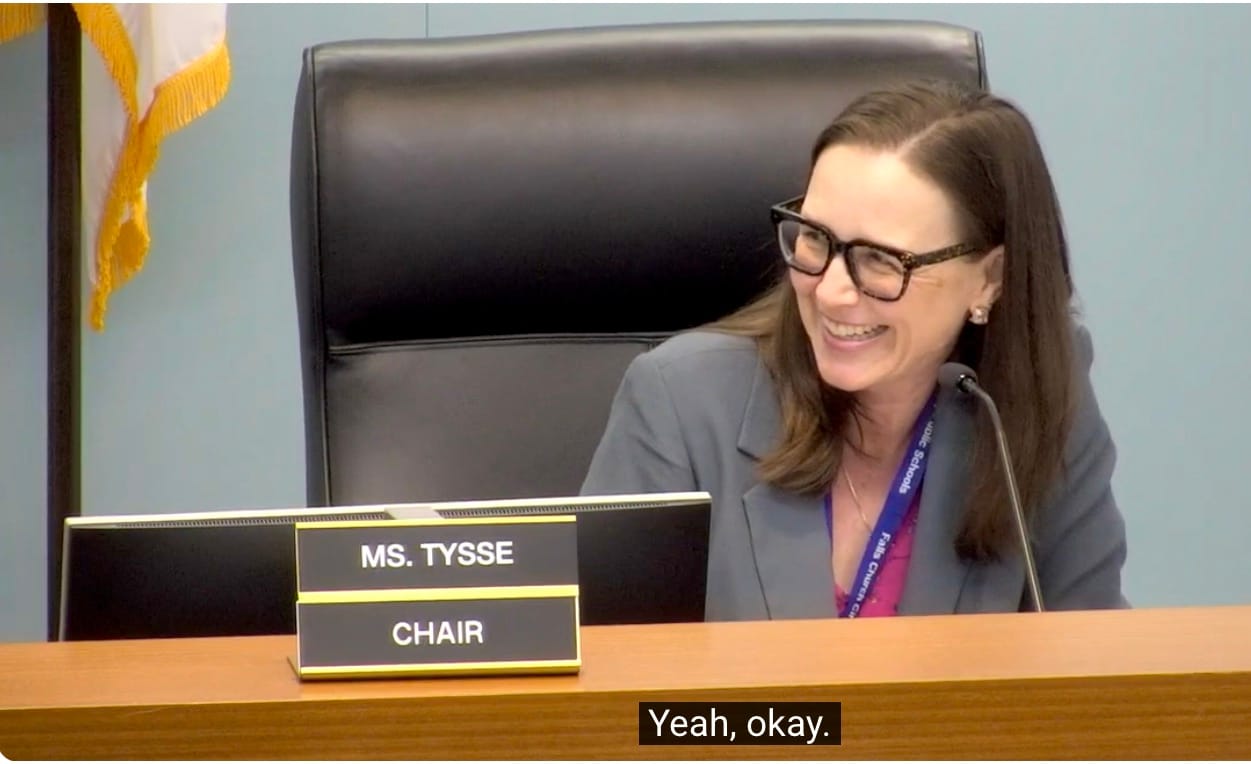
Board Chair Kathleen Tysse then began presiding over the AI segment of the agenda, beginning with her thanks as well: "Yes, I definitely want to echo that and just give yet another strong thank-you to our leadership here on the Board who led that Committee so nicely and all the really important, thoughtful work the Committee did. Reading through this policy, it was so clear how thorough and thoughtful the work was. So thank you very much to you all."
Two Challenges Presented
Board member Bethany Henderson then described the Subcommittee's efforts to incorporate all the varied input received from stakeholders – other School Board Advisory Committees, the Ad Hoc AI Advisory Committee, students, and faculty, etc. – and to formulate a set of AI "policy guiding principles" without getting bogged down in the "operational weeds." The goal was to codify "a comprehensive set of both guidelines and guardrails."
The challenge was to achieve the "right balance between not having AI-generated, information or analyses serve as the 'sole basis' of student work while not "unfairly limiting, in this rapidly changing world, and tying staff hands with what and how AI can be used, because it's changing so fast."

Ms. Henderson then called attention to a "parenthetical" in the draft raising the question of whether "AI being used in curated closed loop spaces" might be considered for future piloting or use at the elementary level. It was for the Board to consider whether it wanted to maintain that parenthetical language, broaden it, or excise it entirely and "leave it to teacher discretion."
Later in the meeting, Board member Dr. Anderson suggested striking altogether the parenthetical reference to any "closed loop" and "curated" pilot AI programs at the elementary level for now. "I think for our first go-around," he said, the Board should stick to the language of "no independent usage" for students at that age-level. Board member Anne Sherwood agreed with Dr. Anderson, saying there might be opportunities to roll out pilot projects in the future, "as we learn more and see how it's being used" at the middle and secondary levels.

In the end, the Board agreed, and selected to simply edit out the parenthetical altogether and leave any potential AI pilot projects to the future.
The Question of Parental Opt-out
Board member Lori Silverman then asked – based on community feedback – whether parents would be able to opt their children out of AI instruction altogether. "So, [Google] Gemini was automatically installed on every laptop," she said. "Is there a way for parents to receive notification and then opt out from their students being allowed to use it? Is that something we should consider?" Board member Henderson responded that while the Subcommittee understood parents' possible concerns, creating a "personalized software experience" for every student would "create very real operational difficulties."
"...We want our students to be AI literate," Henderson said. "That does not mean they need to use it for everything, but they will have to be able to use it, if for no other reason than they know when not to use it." So, a parental opt-out provision would "go against the purpose of actually enabling students to be AI literate."
"So I think what we try to do in the policy is to call attention to the broad strokes of [how] we want to ensure that students develop the critical thinking skills, the writing skills, and the math skills, and all those other skills, independent of AI, and to be evaluated in some part, without their use of AI. So that’s where we’ve tried to thread the needle," Henderson said.

Board member Silverman then pushed back a bit: "But we do oftentimes allow parents to opt our kids out of other things.... like FLE, Family Life Education?.... I'm not sure I buy that it would be so difficult just to say, 'My kid is opted out from AI," even if the Board's view or if the community's view is that AI is a significant tool to be used in the future. If the parent doesn't want it, shouldn't we just say, 'That's fine, your kid won't receive it," or not?"
Board Chair Tysse then appeared to put Silverman's question to rest by differentiating the FLE opt-out allowance from a potential AI opt-out. "I think I understand the concern. [However,] I do think the parallel to FLE is not a very applicable one...," Tysse said, pointing out that the FLE instruction has a very clear start and stop time, so an opt-out allowance is not difficult to administer, whereas, there would be no definitive time-frame for when AI might be used in classes. "So, I understand the point," Tysse said. "I'm just not sure that's the right parallel."
Next, Board member MaryKate Hughes, a former 5th grade teacher, took the floor. She began by voicing a somewhat similar concern to Silverman's that perhaps Google Gemini should not be appearing on elementary school computers if elementary students are not to use AI. "I think it would be very difficult to enforce them not using generative AI if it pops up every time they open their computer," she said. "So, I think that would address some of the concerns, which are coming from parents of younger students, like just making sure our software experience matches the policy as outlined."
Parental Notice Regarding AI Use
Board member Silverman then asked, "Is there going to be notice given to parents when AI is permissible or when it's not permissible? Is there going to be like a letter at the beginning of the year? Are there going be certain projects, maybe, where AI is permissible versus not permissible? – just so the parents have a clear understanding and can work with their children at home...?"
"That's a great question," Board member Henderson then reassured. "So that's accounted for... in lines 143 to 148 of the policy about communication and feedback and will be put into superintendent regulations. So, it's an operational control."
Meridian Already Including AI Rules in Course Syllabi
Superintendent Dade then spoke up to clarify that such requirements "won't be brand new" in the high school. "Meridian has done a fantastic job of folding it into syllabi and things of that nature, so we would kind of replicate that. It wouldn't be a blanket statement, but it would be classroom teachers, buildings, et cetera, would be very transparent with students on when it is permissible and when it is not, and how to navigate that. But it really would be dovetailing with what Meridian's already doing."
"Perfect. Thank you," Silverman replied.

Board Chair Tysse then pressed Superintendent Dade to clarify whether a new AI regulation would be drawn up, or whether it would simply be "folded into the existing technology regulations across all the schools?"
'Fully-vetted regulation' Will Take Time
"No, I think we do need a regulation," Dr. Dade said. "But I think we may need some time to wrap our heads around the policy and things of that nature. My recommendation might be a year from now, to have a fully-vetted regulation that would come before the board."
"The policy as it stands sets some pretty clear guidelines," particularly at the elementary levels, Dr. Dade said. "I would hope that we look at Meridian as they're not going to do much different based on the policy, that they've kind of been the showcase for how to do this correctly. So we'd really be looking at our middle school next, at what does that mean at the middle school level? And then tweaking what we might be doing at the high school level. But all of that would be by way of communication that would go out to families, students, staff at those two levels, on the tail end of this policy being approved."
Dr. Dade then confirmed that communication with stakeholders on AI Policy would be coming in the fall. Board member Henderson then pressed the superintendent on how and when the upper school would move toward "proactively" teaching students "how to use AI ethically," as the policy under discussion would require. Currently, she said, it's on a "classroom by classroom" basis and not part of the core instruction.
Dr. Dade responded that he wanted to be "really crystal clear with the Board" that it would not be possible to create a "fully fledged" professional development plan for the staff, who are "gone until mid-August." That's "not going to happen," he said definitively.
"So how do we work through this as we navigate through the beginning of the year, starting to set parameters around when it's permissible and when it's not, and then start to develop what that AI literacy curriculum might look like?, Superintendent Dade asked. "But that's going to take some time."
Student Concerns: The Question of Consistency

Pressed on the need to respond to student concerns about "inconsistency over what is acceptable AI use from class to class," or even within academic departments, Dr. Dade responded, "I couldn't agree more. We can't have two teachers saying it's okay and two teachers not, all in the same department. That's an absolutely fair expectation, and that would be taken care of right from convocation moving forward."
Strengthening the Language for Both Students and Adults
The discussion then moved toward the question of how to "strengthen the language" prohibiting students, teachers, and staff from generating work "solely on the basis of AI," to "substantially" on the basis of AI. The consensus moved toward an earlier suggestion of the phrasing: "No substantive use of undisclosed AI in high-stake scenarios.’ Board member Sherwood highlighted that this stronger language would cover "certain decisions... on grading, discipline, placement, and special education eligibility."
The new language would read: "Decisions on grading, discipline, placement, special education eligibility, individualized education program development, Section 504 determinations, mental health support, or other consequential decisions must be based substantially on human input."
Board member Henderson, however, stressed the need to avoid putting teachers in too much of a bind. "If a teacher is using [AI tools] to tell [students] to go double-check something, I don't want to preclude that those tools may change, et cetera,' and then if a teacher finds a student using some AI, they say, 'Okay, this is AI, we're done!' That can't happen. But I don't think we want to handicap teachers from using support tools to help them say, "Okay, let me double-check this one for this concern...."
Balancing Non-AI Expertise against AI Literacy
Board member Hughes helped dramatize the importance of phrasing here. "I think we have to have some consistency in our expectations of human-generated content, and particularly in high-stake situations where what is valuable is your expertise – both on the student side and on the adult side. Like, we have to protect the development of that expertise and the expression of that expertise. So, I would definitely be in favor of stronger language there."
Board member Anderson described the delicate balance the Board attempted to reach. Today, you wouldn't want to graduate students who had no idea how to use AI, just as when he was "going through high school.... you wouldn't want to send students out not knowing how to use Excel." At the same time, however, "we as a school district want to inculcate skills that are also evaluated not using AI, because that means they are genuinely and solely the kind of display of student mastery and not from generative AI." He helped the Subcommittee select this phrasing: "Consistent with the goals of course curricula, teachers shall ensure that student skills and knowledge are evaluated in whole or in part through work completed without student use of generative AI."
The Importance of 'Clear Consequences'
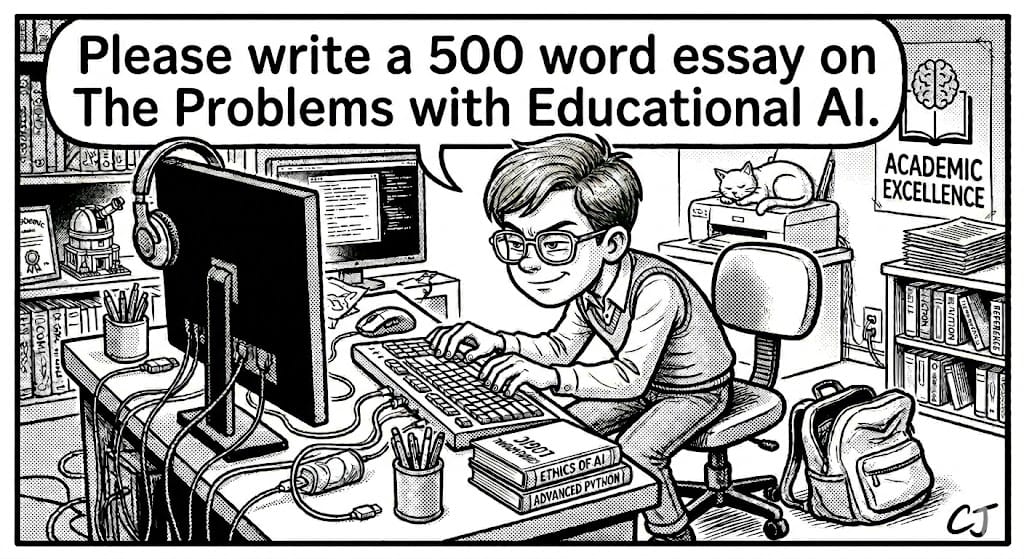
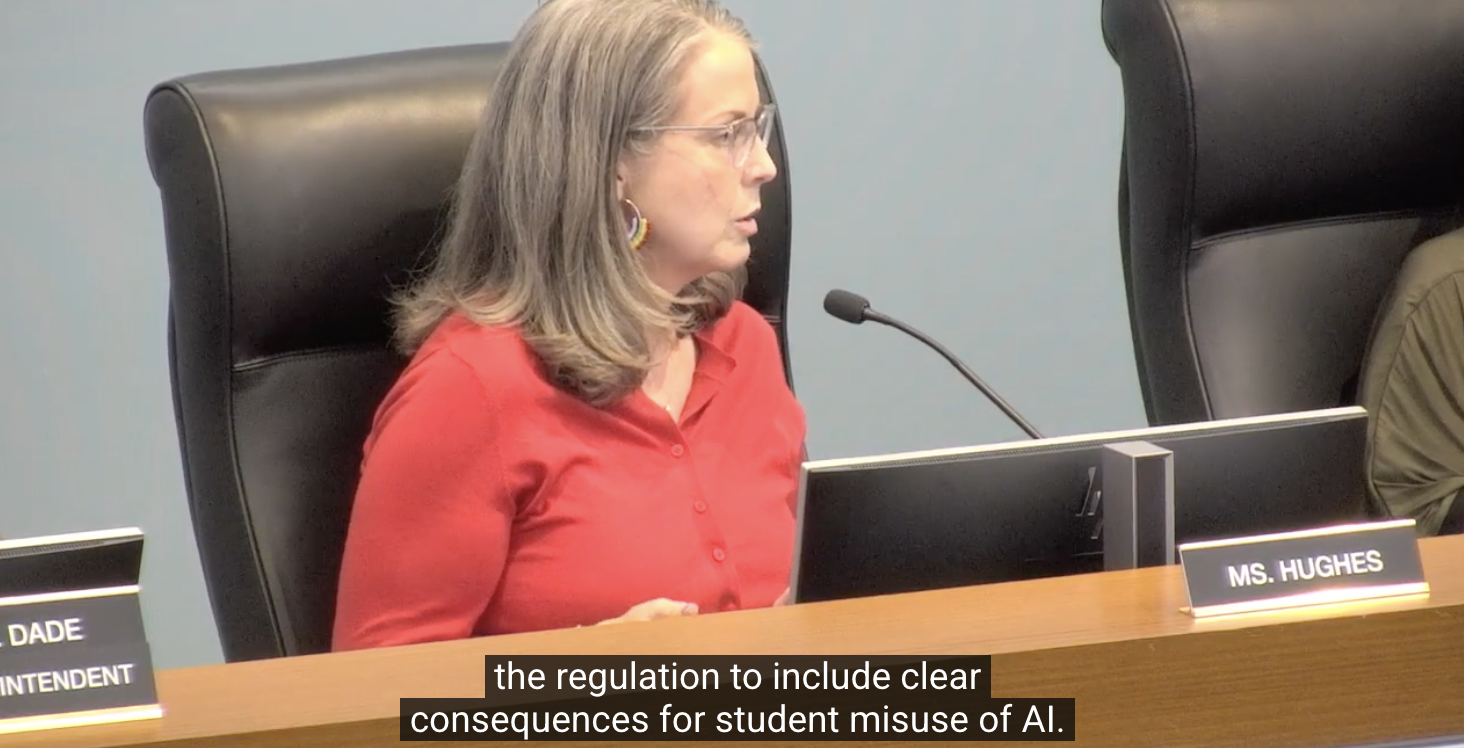
Hughes then stressed the need to "include clear consequences for student misuse of AI" in the regulations. "I think it's too squishy at this point.... We have to provide students and staff with ongoing age-appropriate learning, including uses, limitations, etc., and we have to be clear with them that failure to follow those guidelines will result in a specific and clear consequence. I think that's only fair, and I also think it's necessary given a lot of the feedback we've gotten from students about use of AI at the high school."
"I would love, almost like an Honor Committee," Hughes said. "Students and faculty thinking together about uses of AI and whether it held true to this Policy, and having those case studies available for younger students …. I really do want the learning piece and I want accountability, right?"
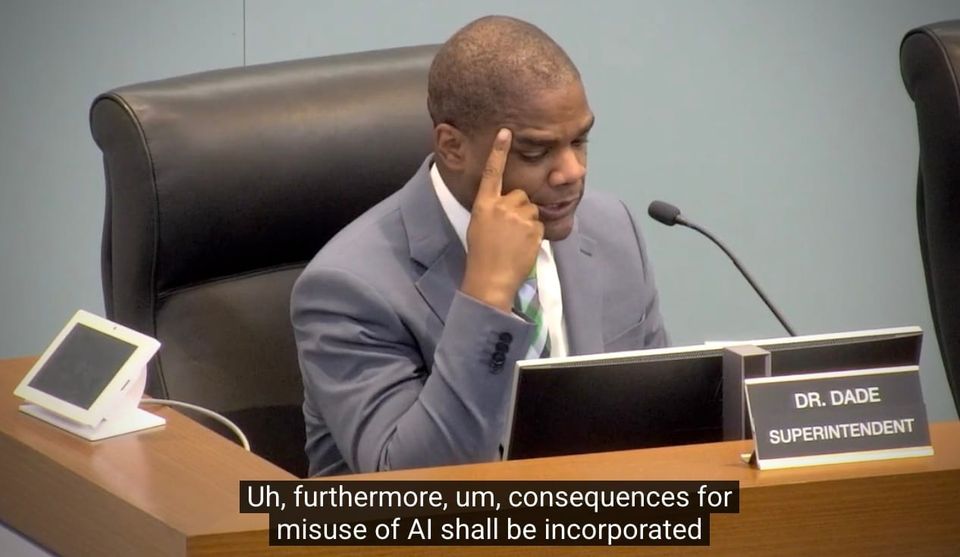
Dr. Dade strongly agreed with Hughes, saying "Clear communication regarding the consequences for misuse of AI would be .... incorporated into the student Code of Conduct."
As the AI Policy portion of the meeting concluded with smiles all around, it was clear the Board is approaching consensus smoothly as only a few "tweaks" and edits were needed to prepare for the policy's "first-reading" before the City Council.
Stay tuned for the School Board's AI Policy presentation to the City Council.... after much discussion, tweaking, and public input, of course.
By Christopher Jones


Member discussion