
FCCPS Adopts First-of-Its-Kind Policy on 'Use of Artificial Intelligence'
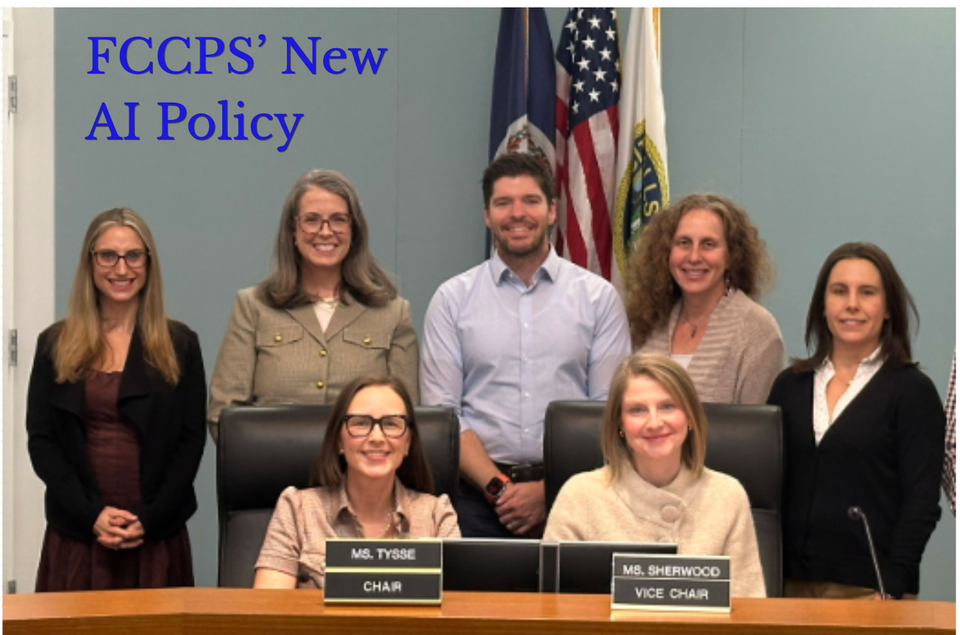
The AI Policy is approved!
With only a few minor edits from first reading, the Falls Church City School Board, with Board Chair Kathleen Tysse presiding, swiftly and formally adopted Policy II/GF, Use of Artificial Intelligence – a first of its kind for the City's public school system – during its final Work Session of the year, Monday evening, June 22.
In its four pages, the newly-adopted policy addresses: Purpose and Scope, Definitions, Guiding Principles, Student Learning and Use of AI, Employee Use of AI, Equity, Accessibility, and Student Supports, Privacy and Data Security, Communication and Learning, and Policy Review.

The new AI Policy serves as a carefully-crafted school district response to the educational concerns arising from the recent proliferation of Generative Artificial Intelligence, defined in the policy as, "a machine-based system that, for explicit or implicit objectives, infers, from the input it receives, how to generate outputs such as predictions, content, recommendations, or decisions that can influence physical or virtual environments." Generative AI, the policy states, is a "type of artificial intelligence that uses patterns learned from data to generate new or substantially modified content, including text, images, audio, video, code, or other digital material, in response to a prompt, query, or other input."
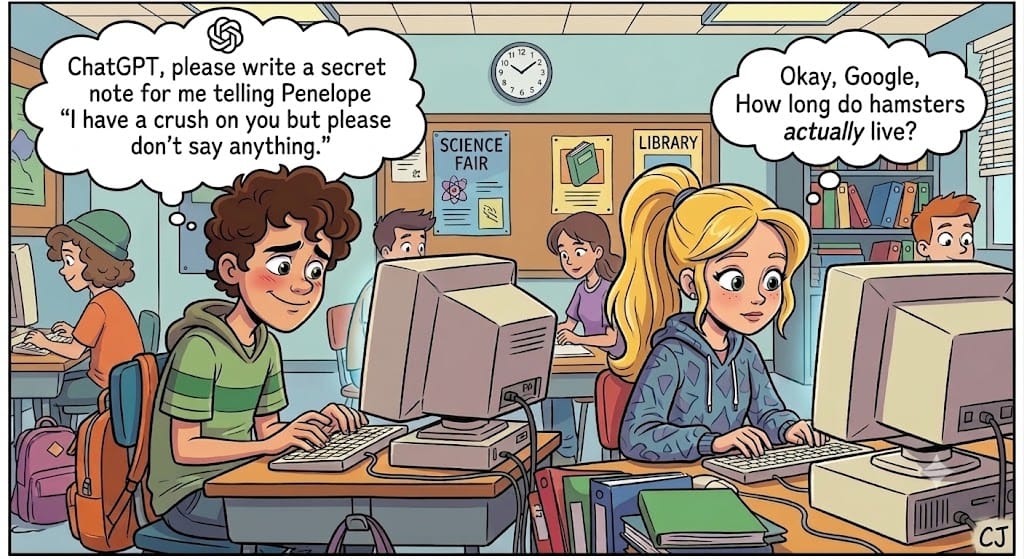
Launched globally only four years ago (initially by Open AI's ChatGPT), Gen. AI has prompted all sorts of concerns in educational environments from students, parents, teachers, staff, school administrators, and even college admissions offices. The list of its potentially negative impacts runs long. It includes providing users incorrect information (i.e., "AI hallucinations,") academic integrity challenges, reduced student skills in brainstorming, critical thinking and creativity, negative impacts on teachers' grading and lesson-planning practices, AI detection tools that occasionally flag student "cheating" inaccurately, widespread copyright infringement, corporate tech commercialization targeting youth, educational AI software costs, and privacy and network security concerns.

The new AI Policy was formulated by the AI Advisory Committee appointed by the School Board this past January. Tasked initially with providing "integrated advice on how FCCPS should govern artificial intelligence in schools" it was charged with crafting a comprehensive systemwide AI Policy based on community-wide inputs. The Committee applied broad-scale expertise to the task as it was comprised of "FCCPS parents with unusually broad and relevant expertise, including AI development, cognitive neuroscience, philosophy, education technology, data science, social-impact software, workforce strategy, special education, clinical social work, cybersecurity, public-sector technology policy, law, and community emergency-service leadership."
A Balanced Approach
Markedly, the AI Policy presents a balanced approach on the Use of Artificial Intelligence in the school system, recognizing both its positive and negative potentials within an International Baccalaureate (IB) framework emphasizing student judgment and ethical development. "The Falls Church City School Board recognizes that artificial intelligence (“AI”) is an emerging technology that may support teaching, learning, accessibility, communication, and school operations when used thoughtfully without replacing human judgment, responsibility, or accountability," the policy states. "The School Board also recognizes [however,] that the use of AI raises important questions about student learning, privacy, equity, academic integrity, developmental readiness, and human connection."

The Primary Theme of the New AI Policy
The primary theme of the new AI Policy is that student learning is the central objective of the school system, with human judgment serving as the guiding force behind key judgments for both students and staff. Therefore, Gen. AI may be used as a limited tool in support of that primary objective. "Artificial intelligence may be used in FCCPS when its use aligns with the division’s instructional goals and supports the development of students’ thinking, research, communication, social, and self-management skills."
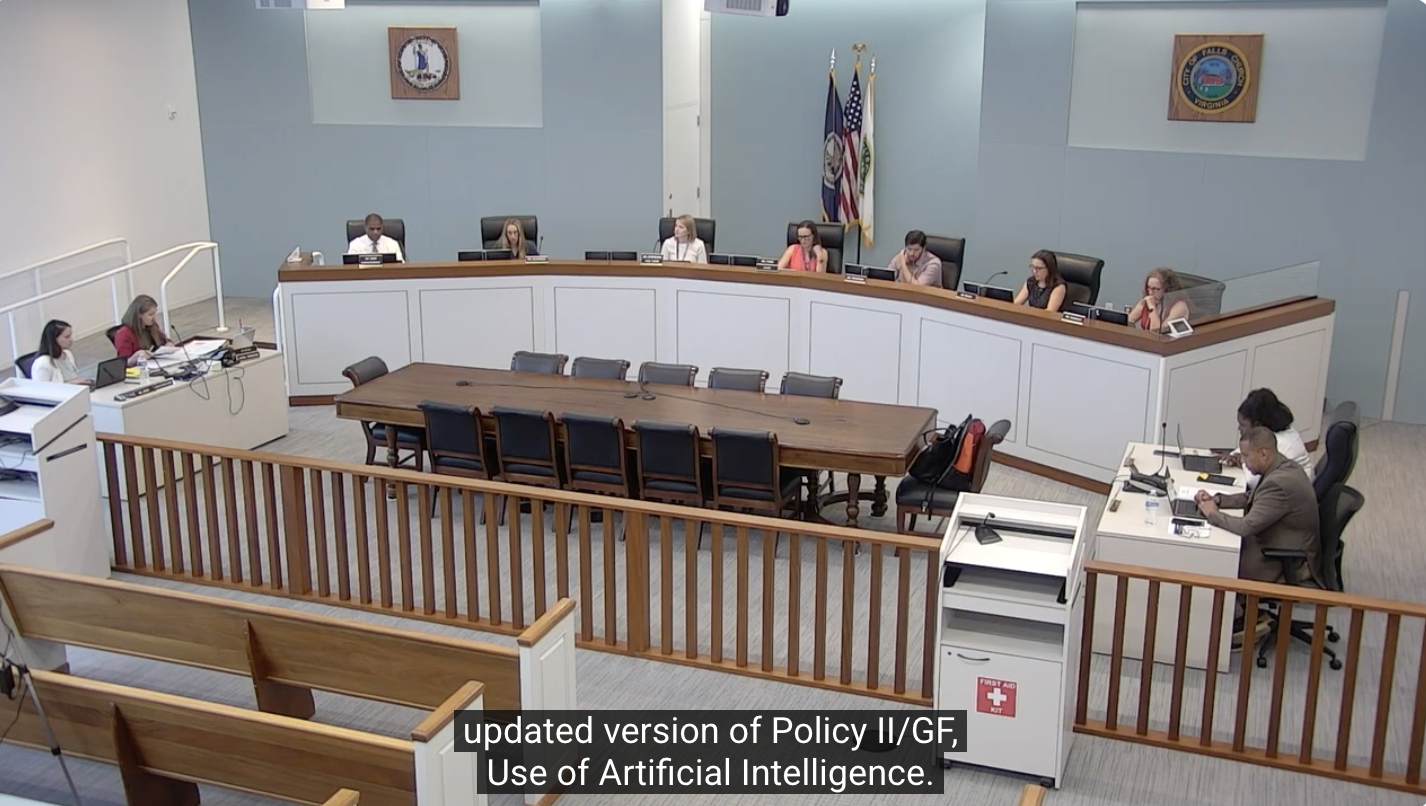
The New AI Policy Applies to Both Students and Staff
"The use of AI in FCCPS shall be human-centered, developmentally appropriate, transparent, equity-aware, and protective of student privacy and well-being. AI use shall support, not replace, the development of students’ critical thinking, creativity, academic honesty, independent judgment, and capacity to evaluate information," the policy continues. "AI use shall augment, not replace, teachers’ and staff’s critical thinking, creativity, and capacity to evaluate information. AI use may never be used in lieu of, or to replace, teachers’ or staff’s independent judgment."
"AI use throughout the district shall be guided by clear educational purpose, evidence of benefit when available, and attention to the risks and limitations of the technology. When used appropriately, AI may support differentiated instruction, accessibility, language translation, feedback, staff productivity, student creativity, information analysis, and preparation for future study and work," the policy states. "At the same time, AI use poses risks through inaccurate or biased outputs, over-reliance, inappropriate disclosure of student data, or substitution for work students are expected to do independently of AI. AI is a tool to support learning and professional practice. It is not a substitute for student thinking, teacher judgment, human relationships, professional expertise, or the responsibilities of the school division."
Student Use of AI
Addressing issues of academic integrity, instructional practices, and academic AI use, the policy's "Student Learning and Use of AI" section covers policy across "all schools" as well as by division (i.e., high school, middle school, and elementary schools.)

Across All Schools
The new AI Policy directs that AI must be age-appropriate, its use guided by divisions and teachers who communicate clear expectations to both students and parents/guardians. The policy stipulates that, "Acceptable student use of AI varies by age, developmental stage, course, assignment, and instructional purpose. Teachers may determine, consistent with division guidance, whether AI use is not permitted, permitted only with express teacher direction, permitted as limited support, or integrated as part of a defined learning activity. Expectations for AI use shall be communicated clearly and consistently to students."
Clear Consequences for Misuse
Under the new AI Policy, students will be clearly informed about the rules governing AI use and held responsible for the misuse of Generative AI. The policy states that "....consequences for misuse of AI shall be incorporated into the student code of conduct."
Student Disclosure, Emphasis on AI-Free Learning and Skill Building
"At all schools, where AI materially contributes to student work, teachers may require students to acknowledge or disclose that use in a manner appropriate to the assignment and grade level. Consistent with the goals of course curricula, teachers shall ensure that student skills and knowledge are evaluated, in whole or in part, through work completed without student use of generative AI," and "At all grade levels, to protect students’ development of IB skills, independent thinking, memory, creativity, discussion skills, collaboration, handwriting, close reading, problem-solving, and human connection, FCCPS shall also provide AI-free learning experiences. "
In the High School: Independent Use, Ethical AI Use, AI Literacy
In the high school, "AI use may include more independent and discipline-specific applications when such use supports learning goals, prepares students for future study and/or work, and remains subject to teacher guidance, transparency, and academic integrity expectations. Students shall continue to be provided meaningful opportunities to learn about how to use AI ethically and to demonstrate independent mastery, original thought, sustained attention, and unaided performance where those capacities are central to the learning objective."
In the Middle School: Teacher-Directed, Structured and Cautious Use
In the middle school, "AI may be used only in structured, teacher-directed activities that help students learn how AI works, where it may be useful, and where it may interfere with learning. Students at this stage should be provided clear expectations about when AI may support practice, feedback, organization, or exploration, and when assignments require unaided thinking or original work."
At the Elementary Level: Teacher-Guided Exploration, No Independent Use
At the elementary levels, "AI may only be used to teach age-appropriate AI literacy through teacher-guided exploration, to help students understand how to critically approach AI technology, or to support teachers’ ability to provide personalized lesson plans or instructions to students. AI may not be used to displace the teaching of foundational reading, writing, numeracy, play, social interaction, creativity, and independent problem-solving. Students may not use generative AI independently."
Equity and Inclusion: 'Considering the Needs of All Learners'
The new AI Policy especially addresses issues of equity and inclusion for every type of learner. "When evaluating AI tools and practices, FCCPS shall consider the needs of all learners, including students with disabilities, multilingual learners, advanced academic learners, twice-exceptional students, and students whose access to technology outside school may vary. AI policies and practices shall not limit approved accommodations, language supports, assistive technology, or other supports needed for equitable access to learning."
Communication Requirements, Clear Expectations, Community Feedback
It also commits each school division to communicate clearly and regularly with parents/guardians about AI use and expectations and to take into account community feedback. "The division shall provide students and staff with ongoing, age-appropriate learning about AI, including its uses, limitations, ethical considerations, risks, academic integrity expectations, privacy implications, and role in future study and work," the policy states. "The division shall inform families about how AI is being used in schools and provide opportunities for community questions and feedback as AI practices evolve. Such communications and community feedback processes shall be made in the format and by the deadline set forth in regulations developed by the Superintendent."
Privacy
Finally, the new AI Policy includes privacy guarantees. "FCCPS shall protect student privacy and data security in all AI use," the policy states. "Personally identifiable student information, confidential records, disability-related information, mental health information, and other sensitive student data shall not be entered into AI tools except through approved division systems and in accordance with applicable privacy protections."
Required Policy Review: Yearly Superintendent Report, Bi-Yearly School Board Assessment
Timely updates and annual and bi-annual reviews of the AI Policy are also required. "Annually, the Superintendent shall report to the Board on how AI is being used within the district and the impact of that use on student learning, teaching, academic integrity, and staff capacity," the policy states. " This policy shall be reviewed by the Board at least once every two years."
Overall, the School Board, in light of a rapidly changing technological landscape, appears to have successfully codified a complex set of expectations, requirements, and guiding principles for students and staff alike. Clearly, they've operated based on community feedback, expert guidance, and especially reasoned human judgment.
For more on Artificial Intelligence, see our recent articles below:
 Christopher Jones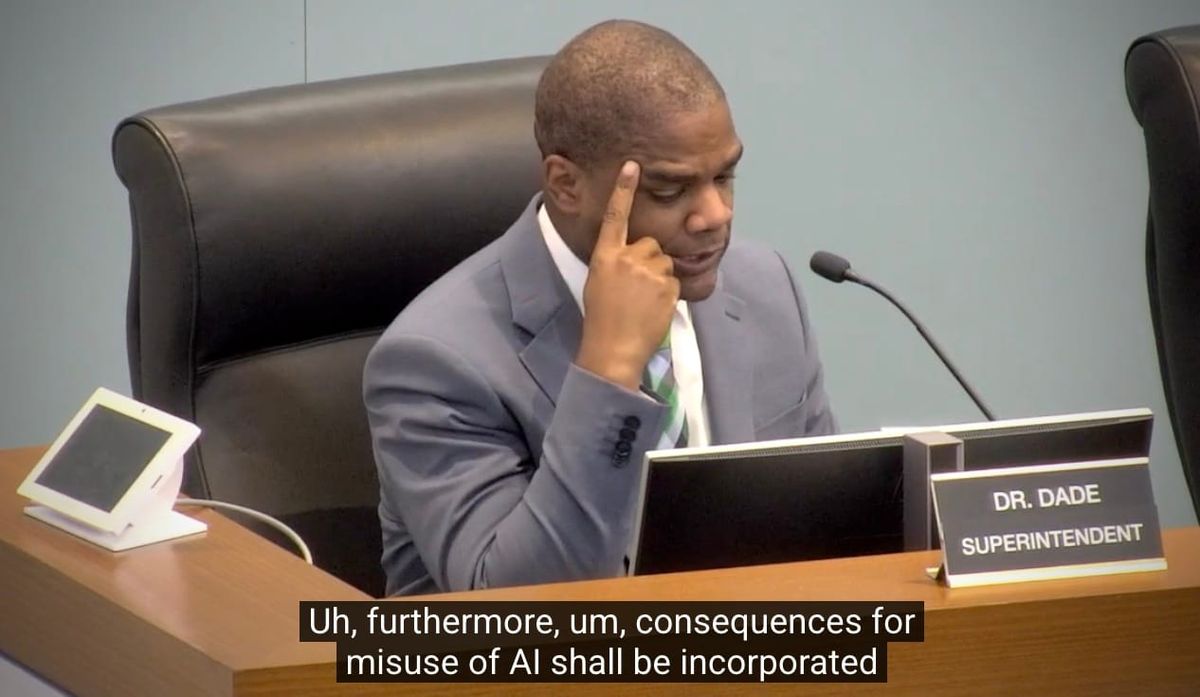
 Christopher Jones
 Christopher Jones
By Christopher Jones



Member discussion