
How Are FCCPS's New AI Policies Faring at Meridian H.S. in 2026?
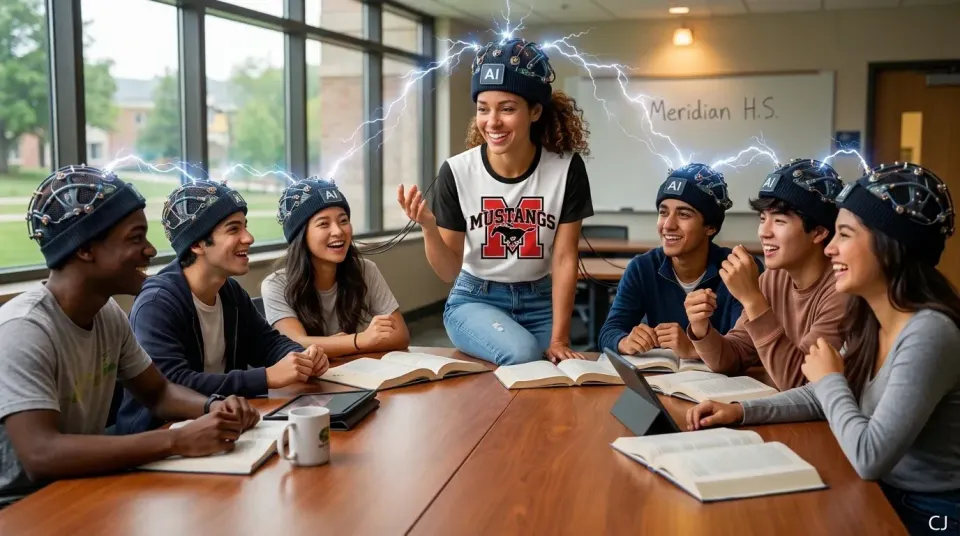
And now we turn to Meridian's new AI policies.
On Nov. 13, The Falls Church Independent interviewed Meridian High School's Principal Peter Laub to examine how the secondary school's new student cell phone policies have been faring so far in 2026.
Here's the piece we published Friday, Nov. 20, based on the first half of our interview with Laub:
 Christopher Jones

Now, we're examining "how Meridian's new AI policies are faring?," as the first quarter of the 2026/2027 academic year's in the books.
When last we looked at Artificial Intelligence (AI) issues in the Falls Church City Public Schools (FCCPS), we lauded the F.C.C. School Board for its thoughtfully constructed and diligently researched new set of AI policies to be implemented in all City public schools this academic year.
Here's the piece we published on June 25, 2026, shortly after the School Board adopted "Policy II/GF, Use of Artificial Intelligence – a first of its kind for the City's public school system," on June 22, 2026:
 Christopher Jones
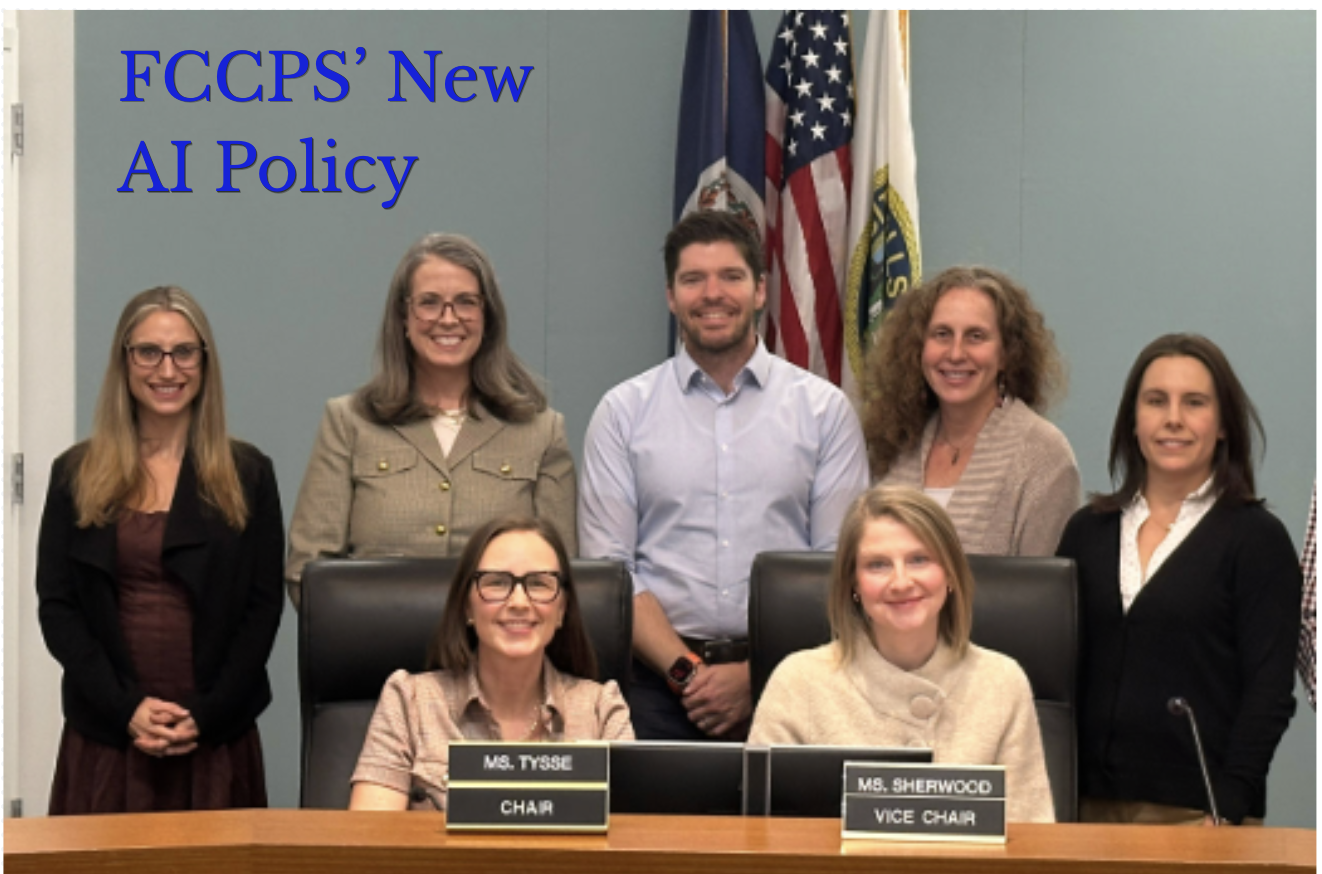
Following is based on the second half of our Nov. 13 interview with Principal Laub, as we pivoted to how students, teachers, and administrators are experiencing the City's new AI guidelines so far this year at Meridian.
We observed that we were "pretty impressed with how careful the School Board was" as it went about creating the school system's new AI Policy. "Agreed," Laub affirmed.
So, how's it been going so far this year, in terms of implementing FCCPS's new AI Policy? "For us at the high school, I think it's been smooth, because we had some of that stuff already in place, just as a regular practice," Laub said. "So November '22 is the date I have in mind of when ChatGPT first came out.... and, you know, it just blindsided us in schools, right? We didn't know about it. The world didn't know about it – but especially us in school. And we immediately went into scramble mode. And I think that's important because, by the time the School Board enacted this policy, we had sort of put in place some of the guardrails that we already felt really comfortable with here at Meridian. We had already been working with teachers around, 'Hey, we need to have explicit language with students on assignments, you know, a clear way to communicate permissibility in different settings....' We also wanted to make sure we were offering professional development for teachers so that they knew and understood this tool."
"We kept coming back to the analogy of Wikipedia. When Wikipedia first came out [in the early 2000s], education got turned upside down because now every kid could get the complete answer right away," Laub recalled. "....'Can't touch Wikipedia!,' right? But now we're like, 'Yeah. You probably should go to Wikipedia first, right? You should engage with that. It's imperfect, of course. And these [AI] tools are way more powerful. But there's a little bit of the initial, 'Don't touch it!' going on. And now we have to say, 'Well, once again, this is woven into the fabric of society. But that said, it's still incredibly challenging."
A Head Start, But Still Challenging

"So, you had a head start, but it's still challenging?," we asked. "Yes. I think what we had a head start on was what I was talking about – the boundaries and professional development for teachers. But I think our high school teachers were well prepared once the School Board policy came out. They could read that and say, 'Hey, we're already doing a lot of that. We feel good about this. Maybe we're not happy about AI in school, but we understand. We kind of know how to work with this." And, I think for the kids, there had already been some explicit teaching going on in classrooms. And as teachers develop professionally, they were taking that back into the classroom: 'Let's talk about appropriate and inappropriate ways to use a chatbot for this class. Or, let's talk about how you cite this for the research.' So all that stuff was kind of there as [the new AI Policy] was getting codified."
The Eternal Cat-and-Mouse Game
So now students understand better the potential implications of just plugging a prompt into AI and turning in the results, because the teachers are showing they're savvy enough? "Yes. But that said, there's the eternal cat-and-mouse game, right? You've been in a school, and you know and understand that cheating is not new. We didn't invent cheating in 2022. Kids have been cheating and trying to cheat in various creative ways forever. In 2022, chatbots gave them a really easy way to do that. So that's just really hard."
So how has the cat-and-mouse game been going? "It's constant. It's just constant," Laub said somewhat wearily. "It's sort of like living with a headache, right? You know it's there and you have to carry on. And there might be moments where you're like, 'Oh, I feel good today, right? But then, you're like, 'Oh, it's back.'
"Sort of like an arms race between students and teachers?," we wondered. "Yeah, a little bit. And one of the solutions to this we're seeing in higher education is more oral exams, more written exams, and more oral presentations.... a lot of our teachers are going back to handwritten things. A lot of our teachers are doing oral presentations and requiring collaborative skills. And, in both instances, [the advent of AI] is forcing schools all the way up through college to re-examine the homework assignment, the lesson plan, the unit plan, and the end project to reduce the opportunity for [cheating and shortcuts.] So, if the assignment is 'Conduct this science lab and here's a 25-question test at the conclusion based on the things we've learned,' That's maybe something AI can do, so it's going to be pretty easy for kids to try to cheat."
A Huge Lift.... and Pandora's Box

So teachers have to keep revising their strategies? "Right. And that's a big lift – a huge lift – for teachers. It's a huge lift for the colleges as well. Actually, it's a huge lift everywhere.... But, as humans, we've evolved," Laub continued. "And we've added this technology into the world. And now Pandora's Box is open. And we're not going back. So, we have to evolve our practices instead."
The Disciplinary Dimension
We were curious whether the new AI Policy has altered the disciplinary environment at Meridian significantly. Turns out, many of the academic integrity rule-enforcing mechanisms were already in place.
"So, when Chat GPT comes out in 2022, we try to adapt, and we try out" AI detectors," Laub said. "So, then we haul Chris Jones [clearly, Prinipal Laub is not referring to this writer!] and his parents in and say, 'Hey, it says here your essay was 80 percent drawn from [other sources].... But, that was already in place because we had tools like Turnitin.com that already existed. And we were doing that before. So now, instead of asking, 'Hey, you didn't buy your essay off the Internet, did you?,' We just ask, 'It looks like you asked a robot to write [your paper], right? So it just became easier."
"And we learned that those AI detection things aren't perfect as well. We also don't want to totally dehumanize the process," Laub continued. "We want teachers to still read [the student's work]. We want to have these key opportunities for discussion. So we're getting better, but we have those systems in place. And we've worked really hard to make them clearer. Kids know. Teachers know. So, when Chris Jones turns in something, we're not immediately going to throw you into jail. We're going to start with a conference. Right? Like, 'Hey, Chris, did you write this? Is this your work? Can you help me understand – you know, the kind of oral repartee that might happen when we say, 'Let's read this together.'"
So, is Laub generally supportive of the School Board's new AI Policy? "I don't have it in front of me, and I didn't memorize it, but I don't think it changed our day to day life significantly," Laub said. "It codified a little bit of what we were already doing, right?"
The Google AI Ecosystem
"But if the question is, does access to AI tools for students cause friction? The answer is 'Yes,' Laub added.
"But, it was already just like Wikipedia was. We could have gone down a pathway – as some schools did – to just totally block this. But, right now, the school's ecosystem is a Google ecosystem. Kids have access to [Google's AI chatbot] Gemini through their school accounts. But, you know, there's another universe in which we could say, 'You don't have access to any of this,' right?" Some schools are even attempting to turn off the AI search option in Google Gemini, while leaving basic Google search. "But, it doesn't work that way," Laub said. "So, it's been tough."
"And I was in education at a time when we taught students how to do Google searches, right? It was like, 'Here's how you do good keyword searches.' And how you'd scroll and sort your responses. But I think the future of this is teaching students how to write good prompts.... That's going to be the outcome. But, the lazy student can still say, 'Hey, Can you do my math homework for me? I don't feel like it.' And that tool wasn't always available, right? You had to at least have a little initiative in your search, like, 'Hey. Who has the answers to tonight's math homework?' [Laughs].
To Adopt the Honor Code Approach?

We wondered whether any new disciplinary structures have been put in place in the wake of the School Board's new AI Policy? Perhaps students signing honor pledges or maybe the establishment of Honor Committees?
"We don't have any student honor committees," Laub said. "We don't have that sort of blanket thing, but we have talked about bringing that back at a molecular level. We have sort of a blanket honor pledge students acknowledge at the start of the school year. But I think that's lost its bearing a little bit in this moment.... That's something I've thought about, though. Decades ago, the school adopted an Honor Pledge that kids used to write on top of an assignment."
Sort of like UVA's Honor Pledge?, we wondered. "Yes. It was actually modeled after that one, in fact. We had staff say this.... But, it's something we're looking at sort of at the granular level, where we say, 'Hey, you need to attach your Honor Statement to your assignment."
One of the problems, however, is that the UVA Honor Code requires students to report infractions committed by fellow students. "Yes, we've flirted with this. But, it's very hard," Laub agreed. "It's hard to build up. And, it's tough developmentally for many students – think about freshmen in high school. That's really tough."
AI Frontier Language
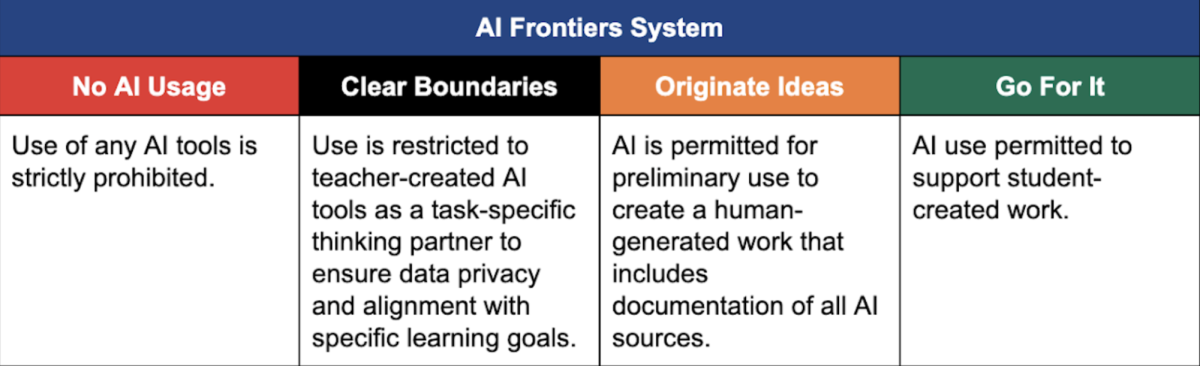
"To go back to your original question, one thing that was new that we definitely were clear on at the start of this year is at the high school we adopted what's called the AI Frontier Language. And it's a simple four-level coding system that all teachers use in their classrooms and with students for when AI is Acceptable Use. We were a little bit of catch-as-catch-can before, where we would tell teachers, 'Hey, be clear with students.' But, we now give them the tool and we've said, 'Everybody's going to use this language.'"
"And we were tired of the conversation with the kids where we kept hearing that they 'didn't know,'" what a teacher's expectations were.
So, teachers use the AI Frontier Language with students and it involves four-tiers of very clear expectations with regard to appropriate AI use. "Green means 'Go for it.' Orange, is 'process only.' Black establishes clear boundaries, and is task specific. and Red means it's absolutely not allowed," Laub said, as he read from a posted flyer of the language in his office. "So now, teachers can put the color right on an assignment or task so the students know for sure."
Working Through Rather Than Around A.I. to Engage Students
So, the cat-and-mouse game is not about the AI Policy itself, but about the evolving technology?, we asked. "Correct," Laub said. "I agree with that. The technology is a beast. And I mean, it's... It is radically changing our society and how we interact with one another. And.... it's not going away. So putting your head in the sand is kind of a bad practice. So, I'm glad the School District developed a policy. And, I'm glad we're engaging with students on using it. But that means it comes with those challenges."
"I think sitting here talking through all of this underscores for me, the challenge of being an educator in 2026," Laub reflected. "It was hard before. And it was a lot of work before, but it's really hard now, right? I think just at the secondary level – which is the level I know most intimately – it's a lot. So, for all the excitement that comes from, 'I want to have students read this essay and then we'll talk about it and engage in new ideas from it,' there are so many ways for kids to disengage and not read it or short circuit that assignment and still fake their way through it. And that makes life really hard. I understand. So I think that's just where education's tough today."
"And these folks [teachers] are working their tails off to make it engaging for kids and to push their thinking," Laub said. "And the AI tools are a part of it now. So we just have to work through them rather than around them."
Teachers Must Use Own Voices as Well
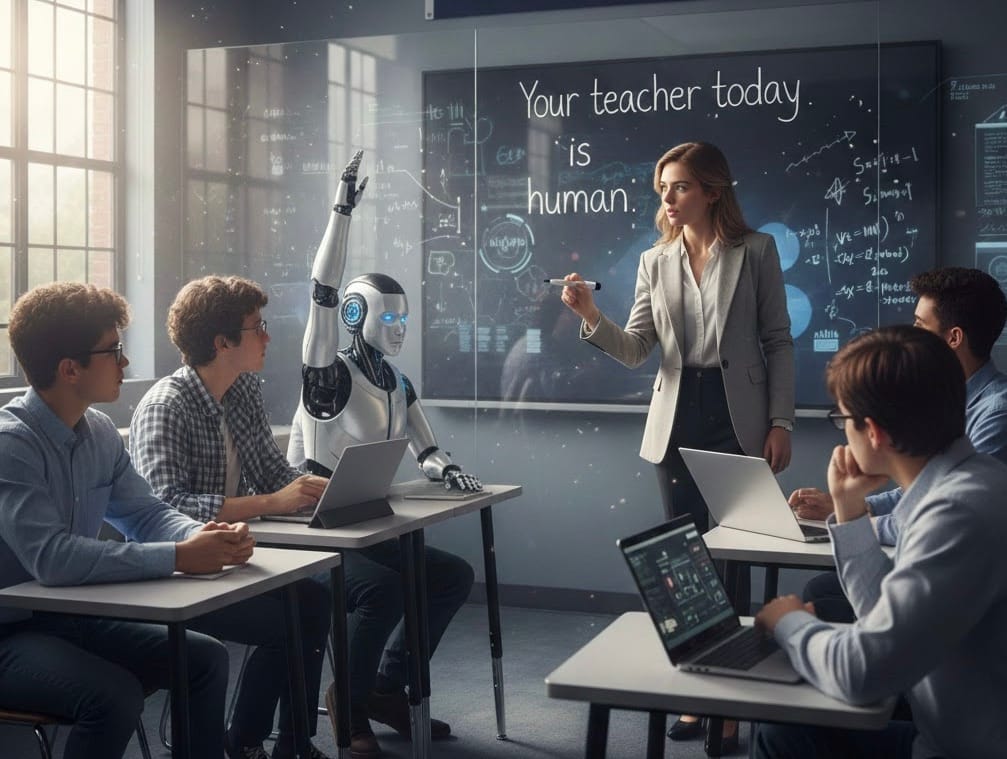
We were curious whether Meridian had "any problems with staff or faculty using AI-generated language rather than their own."
"I think you wrote about this when we [held a roundtable discussion] with the students in the library. They brought that up. They said, 'Yeah, they were frustrated." And I'm sympathetic to that. Because.... the best part about teaching is building relationships with students so they want to learn. And they want to be curious about the thing that you're curious about. That's the best part of teaching. And AI can really cut that out. So I don't want to live in a universe where the robot teaches... Or, the teacher is asking a robot to generate a prompt, while the kid's asking the robot to write it, and then the teacher's asking a robot to grade it. That stinks. But that could happen; and that's pretty terrible."
A 10-Minute Pop-In from the Principal
Hopefully, proper professional development can steer teachers away from such a nightmare.
"Yes," Laub said. "And the creative ones use [AI] to their advantage.... I was in a higher level math class recently and it was so cool. They were doing complex math on the whiteboard and everything. But what kids were then doing was challenging AI afterwards, asking 'Hey, can you solve this in a different way?' And then poosing questions, like, 'How did you get to this?,' right? 'I used this way, what did you use?'"
"And this is what I mean by going through it rather than around it," Laub said energetically. "And another version of that is that the teacher could have just not been engaged with the kids. The kids could have just taken the question and typed it in. But with all these kids – there was all sorts of noise in the room. They were talking to each other and they were happy, and frustrated, and were like, 'Check this!' and, 'Do this!'
Fortunately, the 10 minutes Laub spent popping into this math class provided great "anecdotal evidence" that AI can be employed successfully for both learning and engagement in the classroom. "Let's build up the students’ efficacy in how to use this in a way that is healthy and still going to help you grow as an individual," the class visit informed Laub.
By Christopher Jones




Member discussion